



An off-peak EV charging AI schedule uses smart apps and connected chargers to automatically fill your battery during the cheapest electricity windows, typically overnight or mid-afternoon, while guaranteeing your car is ready by your chosen departure time. Instead of manually setting timers or guessing when rates drop, AI-driven scheduling layers in your tariff’s price signals, grid carbon intensity, and your daily routine to optimize every charge.
- Off-peak EV charging AI schedule in a nutshell
- Off-Peak EV Charging AI Schedule
- Choosing the right tools for smart EV scheduling
- Step-by-step: build your first AI charging schedule
- Sample off-peak schedules for common UK and DE homes
- Balancing battery health with AI optimisation
- Avoiding conflicts between car, charger and tariff apps
- Using home batteries and solar with smart EV charging
- Frequently Asked Questions
For UK homeowners on time-of-use tariffs like Octopus Intelligent Go or OVO Charge Anytime, this can cut charging costs by 50-70 % compared to flat-rate daytime electricity. German drivers on dynamic or night-rate contracts see similar gains when pairing a smart wallbox with tariff APIs or vehicle telematics.
Off-peak EV charging AI schedule in a nutshell
An off-peak EV charging AI schedule is an automatic plan that tells your car or home charger to draw most of its energy during the cheapest, cleanest grid hours, without you micromanaging timers. In the UK and Germany this usually means charging overnight or at specific low-demand slots that match your time-of-use or dynamic tariff. The AI part is the software (in your car app, wallbox app or tariff app) that forecasts prices, grid carbon intensity and your driving needs, then adjusts start/stop times and charge rate to hit your chosen departure time and battery level.
In practice, you set three things once: your usual departure time, minimum charge needed (for example 60% by 7:00), and which tariff you’re on. The off-peak EV charging AI schedule then shifts most charging into off-peak windows (such as 23:00-07:00 in many UK dual-rate tariffs, or low-price Viertelstunden in German dynamic tariffs), pauses or slows when prices spike, and can top up briefly in peak hours only if absolutely necessary. Some apps also learn your weekly patterns and adjust automatically if you often leave earlier on certain days.

Key benefits for a typical UK or German home are clear:
- Lower bills: AI charging concentrates kWh in the cheapest bands, often cutting home charging costs significantly compared with flat or manual charging.
- Lower carbon: The schedule can favour hours with more wind or solar on the grid, which in both countries often coincide with overnight or windy periods.
- Less hassle: You plug in and walk away; the system manages timers, changing tariffs and one-off early departures for you.
- Grid-friendly: Spreading load into off-peak hours reduces strain on local networks, supporting EV charger safety standards in the UK and Germany.
Related internal resource cheapest EV charging tariff UK.
Off-Peak EV Charging AI Schedule
To build an effective off-peak EV charging AI schedule, you first need to understand when electricity is cheapest and why it changes. In both the UK and Germany, prices now vary by time of day, and increasingly by hour, which is exactly what AI charging apps and smart wallboxes exploit.
There are three main structures you will see on EV tariffs in 2026-style offers:

- Flat pricing: One price all day. Simple, but usually the most expensive for heavy EV use.
- Time-of-use (TOU): Fixed peak and off-peak windows (for example, cheap overnight, expensive early evening). This is the most common structure for smart EV tariffs in the UK and is growing in Germany.
- Dynamic/spot pricing: Prices follow wholesale markets hour by hour. You may see ultra-cheap or even negative prices on windy nights and high spikes on cold, still evenings.
On a modern UK EV tariff, you might see daytime electricity around 25-30p/kWh, with an off-peak window at roughly 7-10p/kWh overnight. In Germany, base household prices are typically higher, but some suppliers now offer EV add-on tariffs where night-time or dynamic low-demand hours can be 30-50% cheaper than the daytime rate. With dynamic tariffs in either country, individual low-price hours can be dramatically cheaper than the standard rate, while short peak windows get very expensive.
This difference matters more for a full charge than for single appliances. An average home charge from 20% to 80% on a mid-sized EV can easily use 30-50 kWh. The table below shows how that translates into real costs using typical 2026-style UK and German examples, assuming a 40 kWh session:
| Country | Price type | Price per kWh | Cost for 40 kWh |
|---|---|---|---|
| UK | Peak | 30p/kWh | £12.00 |
| UK | Off-peak | 8p/kWh | £3.20 |
| Germany | Peak | 38c/kWh | €15.20 |
| Germany | Off-peak | 22c/kWh | €8.80 |
That range is the core saving your off-peak EV charging AI schedule is targeting: in the UK example, almost £9 saved every full home charge, and in Germany, over €6.
Related internal resource EV charger installation cost UK 2026.
Choosing the right tools for smart EV scheduling
To run a reliable off-peak EV charging AI schedule you need three layers that work together: something that controls the car (car app or wallbox), something that knows your tariff (supplier or platform), and a basic safety framework that keeps load within limits in the UK and Germany.
| Tool type | Who controls? | Main strength | Main risk |
|---|---|---|---|
| Car app only | Vehicle | Simple, no extra kit | Can ignore tariff shifts |
| Wallbox app | Charger | Stable timing control | Needs correct tariff |
| Supplier smart tariff | Energy supplier | Knows real-time prices | Vendor lock-in |
| Whole-home platform | Cloud gateway | Optimises car and home | Setup complexity |
Car apps (Tesla, VW, BMW, Hyundai, etc.) are the lightest way to start. You usually set a target departure time, desired charge level, and sometimes a cheap-rate window. For a basic fixed off-peak window in the UK or Germany, this can be enough. Downsides: the car may not understand complex dynamic tariffs, can wake and re-start charging at odd times, and may clash with a smart wallbox trying to do its own schedule.
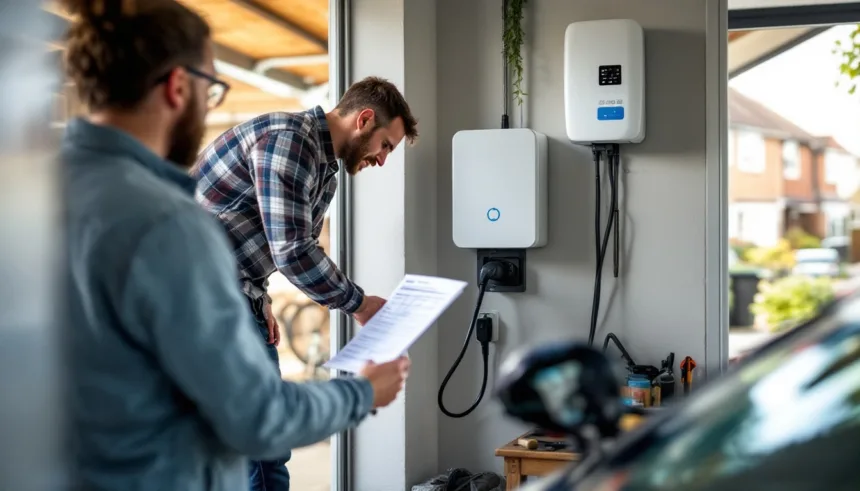
Wallbox apps from chargers such as Easee, Wallbox, Ohme, or go-e often expose more granular control of amps, start/stop times, and load management. Many can follow a cheap-rate window and apply a simple algorithm to fill your target kWh inside it. If you rely on the wallbox, you normally disable the car’s native schedule to avoid conflicts. In Germany, wallbox control is also helpful when working with grid-limited connections or KfW-funded load management, because it can throttle current safely.
Supplier smart tariffs in the UK (for example, off-peak EV tariffs that shift prices nightly) and time-of-use tariffs in Germany add the price intelligence. Some link directly to specific cars or chargers and run an off-peak EV charging AI schedule in their own app: you tell them your departure time and minimum SOC, and they choose the hours.
Step-by-step: build your first AI charging schedule
Before you touch an app, write down four basics: your EV’s usable battery size (kWh), your typical daily mileage, your home charging power (kW, e.g. 7.4 kW wallbox or 2.3 kW granny cable), and your tariff’s off-peak hours and prices. In the UK and Germany that usually means a cheap night window of 3-8 hours; check your supplier app or bill for exact times and any shoulder rates. This is the core data every off-peak EV charging AI schedule will lean on.
Next, choose your main “brain”. You normally have three overlapping options: the car’s own app, your wallbox/smart plug app, or your energy/tariff app. For reliability, pick one as the master scheduler and turn off time-based scheduling in the others to avoid conflicts. Keep only safety features (like charge limits or max current) enabled in secondary apps.
- Set your target departure time for weekdays and weekends separately if the app allows. Aim for the time you actually leave the driveway, not when you wake up.
- Choose a minimum state of charge (SoC) you always want by departure, 60-70% suits most commutes; go higher only when you really need range.
- Tell the app your tariff: either by selecting your supplier and plan if integrated, or by entering peak and off-peak prices and time windows manually. If it asks for a “max price per kWh”, set this just above your off-peak rate so it avoids daytime top-ups.
- Add your car details: model, battery size, and location. If possible, let the app read SoC directly from the vehicle API so it can adjust in real time; otherwise, enter an estimated starting SoC the first night.
- Enable the smart or AI mode. Look for wording like “optimize for cost”, “smart charging”, or “AI schedule”; confirm that it shows planned charging only inside off-peak hours, with enough total kWh to hit your target SoC.
- On your EV’s in-car screen, disable its own departure timer and built-in scheduling, leaving only features like battery protection or charge limit (e.g. 80%) turned on. This prevents double-scheduling that could stop charging altogether.
- For the first night, plug in at least an hour before off-peak starts. Check that the car connects, then confirm that charging either pauses until the cheap window or ramps gently according to the AI plan.
- In the morning, verify that your SoC is at or near the target. If it’s short, nudge the target SoC up 5-10% or widen the allowed charging window by 30-60 minutes in the app.
- Repeat this for a full working week. Each evening, note three things: start SoC, planned finish time, and actual morning SoC. If the car consistently finishes much earlier than departure, you can lower the target SoC slightly or tighten the price cap so more charging happens in the very cheapest slice of the night.
- After a week, lock in your “steady state”: keep your weekday schedule, then clone or adjust it for weekends when you might leave later or skip charging entirely. Set reminder notifications for when the vehicle isn’t plugged in by a certain time so the AI schedule has something to work with.
Sample off-peak schedules for common UK and DE homes
These examples show how an off-peak EV charging AI schedule can adapt to different UK and German households. Assumptions are kept simple and indicative only; real savings depend on your car efficiency, tariff, and driving pattern.
| Lifestyle | Country | Main goal | Key charging window |
|---|---|---|---|
| 9-5 commuter | UK | Cut workday costs | 00:30-04:30 |
| PV family | DE | Use solar first | 11:00-15:00 |
| Shift worker | UK | Match changing shifts | 02:00-05:00 |
| Retiree | DE | Max comfort, low cost | 01:00-05:00 |
1. UK 9-5 commuter (no solar, time-of-use tariff)
Profile: Drives ~40 miles per weekday, plugs in most nights, needs car ready by 07:00. Off-peak rate roughly 7p/kWh vs 30p/kWh peak.
Typical AI schedule: Car or wallbox app set with a 07:00 departure and 80% SOC target. The AI looks at tariff data and back-calculates:
- Plug-in: 18:30
- Smart charging window: 00:30-04:30 (off-peak block)
- Target SOC: 80% on workdays, 60% on weekends
- Charging nights: ~20 per month
Indicative impact: Around 18-20 kWh per workday (for 40 miles) moved from peak to off-peak. That can mean roughly £25-£35/month saving and a modest CO2 reduction if more charging lands in lower-carbon overnight generation.
2. German family with PV and smart wallbox
Profile: Detached house, 7 kWp solar, two drivers sharing one EV, ~800-1,000 km/month. Daytime solar often available; grid prices higher in the evening.
Typical AI schedule: Wallbox app set to “solar-first” with a minimum SOC for reliability:
- Plug-in: 16:00-18:00 most days
- Solar-priority window: 10:00-16:00 (next day)
- Grid-top-up window: 01:00-04:00 if battery still below target
- Target SOC: 70% weekdays, 90% before long trips
Indicative impact: A large share of charging (often 40-70% in sunny months) can come from self-consumed PV, with off-peak night top-ups. That can cut monthly charging bills noticeably compared with pure evening charging, and push CO2 intensity down because PV power replaces grid imports.
3. UK rotating-shift worker (NHS, logistics, hospitality) Profile: Irregular start times (06:00, 14:00, 22:00 shifts), ~1,200 miles/month, relies on the car for work. Off-peak window might be 00:30-04:30 but departure times change weekly.
- Early shift week: departure set to 05:30, smart window 00:30-04:30, SOC target 90%
- Late shift week: departure 13:00, AI may charge partly mid-morning if a cheaper shoulder rate exists
- Night shift week: departure 21:00, AI often finishes charging just before 20:00 if peak prices end at that time
- Preferred ready-by time: 09:00 daily
- Target SOC: 60% standard, 90% before planned trips
- Smart window: 01:00-05:00 (cheaper night band if available)
- “Minimum SOC” safeguard: 40% at all times
Balancing battery health with AI optimisation
AI tools make it easy to squeeze maximum savings from an off-peak EV charging AI schedule, but you still need to hard-code a few rules that protect the battery. Modern EV packs are robust, yet repeated full charges, deep discharges and extreme temperatures can still accelerate wear. Treat AI as an optimiser inside those limits, not the owner of the limits.
A simple starting rule set is the “20-80” approach for everyday driving. Try to keep state of charge (SoC) between roughly 20% and 80% for routine use, only going closer to 100% before longer trips. In most car apps you can set a target SoC cap (for example 75-80%) and let the AI charging schedule work within that ceiling. For nights when you need full range, temporarily raise the cap to 90-100% and schedule the final top-up to finish just before departure, rather than sitting full for hours.
Temperature also matters. Batteries are least happy when they are both very full and very cold or hot. If your EV or wallbox app supports it, pair your off-peak schedule with preconditioning: trigger cabin/battery warm-up while still plugged in, close to departure, so the pack is at a moderate temperature when you start driving. In winter, you can also allow the AI to start charging a little earlier in the off-peak window at lower power, which generates gentle heat rather than a hard, fast charge right at the coldest time.
To encode all this into an intelligent schedule, define non-negotiables first: minimum SoC you want by morning (for example 40%), normal SoC cap (75-80%), and latest departure time.
Avoiding conflicts between car, charger and tariff apps
Most charging problems on smart tariffs in the UK or Germany come from too many apps trying to control the same session. Your car app, wallbox app and energy supplier app can each pause, delay or cap the charge. When they overlap, your off-peak EV charging AI schedule can fail silently, leaving you with an undercharged battery in the morning.
Pick one system to be the “master” and simplify the rest. A good rule of thumb:
- If your EV has strong scheduling (e.g. clear end-time and charge limit), let the car be master and disable any smart schedule in the wallbox and supplier app.
- If your wallbox has the best tariff integration, let the charger be master, set the car to “charge immediately”, and turn off supplier app scheduling.
- If your supplier app has a guaranteed off-peak window and automation, keep that as master, and set both car and wallbox to always charge when power is available.
Once you pick a master, turn other systems to the simplest possible mode: no timers, no departure times, no smart preconditioning. In the car app, clear all schedules and “off-peak” settings if the charger or supplier is in charge. In the wallbox app, disable AI optimisation, dynamic load control tied to time-of-use, and any “eco” mode that tries to shift hours. In the supplier app, turn off smart boosts or “charge now” overrides once you’ve tested your baseline schedule.
Using home batteries and solar with smart EV charging
If you have solar, a home battery or both, the aim is to let an AI tool juggle three sources for your EV: surplus PV first, then cheap off-peak grid import, and only occasionally your home battery. A good off-peak EV charging AI schedule should avoid draining the house battery too low for morning use while still filling the car cheaply and, where possible, with lower-carbon electricity.
| Source | When to use | AI priority | Notes |
|---|---|---|---|
| Solar PV | Midday surplus | Highest | Free, low CO2 |
| Off-peak grid | Night window | Medium | Cheap, predictable |
| Home battery | Short top-ups | Lowest | Protect cycles |
In practice, set your wallbox or energy app to “solar-first” or similar, then add a time-of-use rule for your off-peak window (for example 00:30-04:30 in the UK, or a utility’s Nachtstrom in Germany). The AI can then decide hour by hour whether to pull from PV, top up the EV directly from off-peak grid, or very lightly from the house battery if you need a guaranteed morning range. If your tools don’t integrate, keep it simple: reserve the home battery for the house and use scheduled off-peak charging for the car.
Safety and compliance matter when you automate. In the UK, home chargers must usually be smart and conform to current EV charger safety standards; Germany has its own VDE and grid-operator rules for controllable loads. Before you lean on an off-peak EV charging AI schedule, confirm your charger has DC leakage detection, load management and proper RCD protection, and that it was installed by a qualified electrician. Use strong unique passwords, enable two-factor authentication in your apps where available, keep firmware updated, and only give charger access to household members.
Grid-friendly defaults reduce local stress and nuisance.
- Every 30 days: Check one bill against a pre-EV or flat-tariff month; confirm most kWh went into off-peak or solar; adjust your target state of charge if you regularly over- or under-charge.
- Every 6 months: Re-read your tariff rules, update your expected weekly mileage, adjust seasonal start/stop times (e.g. shorter off-peak windows, different solar output), and re-run any in-app optimiser so the AI can learn from your new pattern.
Authoritative resource: How to Schedule EV Charging During Off-Peak Hours (And ….
Frequently Asked Questions
What time is off-peak car charging?
Off-peak car charging in the UK is often between 23:00-07:00, or tighter windows like 00:00-04:00 on specialist EV tariffs. In Germany, cheaper hours usually fall between 22:00-06:00, varying by region and supplier.
What is the cheapest time of day to charge your electric car?
The cheapest time is usually late at night. UK EV tariffs often drop from around 25-35p/kWh peak to roughly 5-15p/kWh between about 23:00-07:00.
In Germany, night rates can be several cents cheaper than daytime.
Can you schedule EV charging?
Yes. You can schedule EV charging in three main ways: using the car’s built-in charging schedule, a smart wallbox app, or an energy supplier/tariff app.
Should I charge my EV to 100% every night?
Daily 100% charging is usually unnecessary and can increase long-term battery stress. For most drivers, aiming for about 60-80% as the normal target in your off-peak EV charging AI schedule is healthier.
Charge to 90-100% only before longer trips or if your manufacturer explicitly recommends it for your specific battery chemistry.
What is the best charging routine for an electric vehicle?
A solid routine is: plug in most nights, set an 60-80% charge limit, and let an off-peak EV charging AI schedule fill the battery mainly between about 23:00-06:00.
Setting up an off-peak EV charging AI schedule takes an hour of initial configuration but pays dividends every night: lower bills, reduced grid strain, and a fully charged car each morning without manual timers. Start by confirming your tariff’s off-peak windows and API availability, then enable smart charging in your vehicle app or wallbox interface, set your departure time and minimum charge level, and let the algorithm handle the rest.
Monitor the first week’s session logs to verify timing and costs, adjust your departure buffer if needed, and enjoy hands-free optimization.