



EV charging speeds explained home: the difference between a 3 kW trickle charger and a 22 kW wallbox can mean the gap between waking up to a full battery or scrambling for a public rapid charger mid-week. At home, charging speed is measured in kilowatts (kW) and determines how many miles of range you add per hour.
A typical 60 kWh electric car on a 7 kW home charger recovers around 30 miles per hour, filling an empty battery in roughly eight hours overnight, ideal for most UK and German households on time-of-use tariffs. Slower 3 kW units suit plug-in hybrids or low-mileage drivers, while faster 11 kW or 22 kW installations make sense only if your car, supply and budget align.
EV charging speeds explained at home
When people search for “EV charging speeds explained home”, they’re really asking: how quickly can I add useful driving range from my driveway or garage? At home, charging speed is measured in kilowatts (kW), the power flowing into the car, and your battery size is in kilowatt-hours (kWh). Roughly, charging time = battery size (kWh) ÷ charger power (kW). Range per hour is simply how many kWh you add in an hour multiplied by your car’s efficiency.
In UK and German homes, there are three practical speed bands. Slow charging uses a 3-pin plug or “granny” cable at around 2-3 kW. That typically adds about 10-15 miles (15-25 km) of range per hour and can take 15-25 hours to refill a 60 kWh battery from low. It’s workable for occasional or low-mileage use but not ideal long-term.
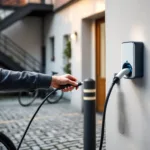
Fast home charging comes from a dedicated AC wallbox, usually 7 kW in the UK and 7.4-11 kW in Germany depending on the supply.
Related internal resource how does home EV charging work.
EV charging speeds explained home
When you see “EV charging speeds explained home”, you’re really comparing three broad levels: slow (around 2-3 kW), fast (7-11-22 kW AC), and rapid DC (50-350 kW). At home in the UK and Germany, slow and fast AC matter most; true rapid DC is usually motorway or public-site only.
| Type | Power | Where used | 60 kWh: 10-80% |
|---|---|---|---|
| Slow | 2-3 kW | 3-pin / small AC | 14-18 hours |
| Fast | 7 kW | UK wallbox | ~6 hours |
| Fast | 11 kW | DE wallbox | ~4 hours |
| Fast | 22 kW | 3-phase only | ~2 hours* |
| Rapid DC | 50-350 kW | Public sites | 20-40 min* |
*Only if the car’s onboard AC or DC hardware supports these speeds; many UK and German family EVs are limited to 7-11 kW AC and 100-150 kW DC, so the theoretical maximum is rarely hit in practice.
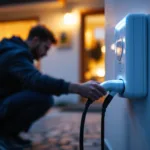
At home in the UK, most properties have single-phase supply, so “fast” usually means a 7.4 kW wallbox, turning an overnight charge into roughly 30-35 miles of range added per hour for a typical 60 kWh EV. In Germany, three-phase power is common, so 11 kW home chargers are standard, pushing that closer to 45-50 miles per hour of charging. While 22 kW AC is possible on three-phase, many cars cap AC charging at 11 kW, so going higher often brings no extra real-world benefit.
Rapid and ultra-rapid DC (50-350 kW) can refill a compatible battery from 10-80% in under an hour, but these units are too power-hungry and costly for normal homes.
What limits your EV charging speed at home
When people search for EV charging speeds explained home, they usually discover there isn’t a single “speed”, several bottlenecks stack together. Your car, your house wiring, and even the weather can all cap how quickly energy flows into the battery.
| Limiter | Typical Range | Who Controls It | Effect |
|---|---|---|---|
| Onboard AC charger | 3.6-22 kW | Car maker | Hard cap on AC speed |
| Battery & SoC | 0-100% | Car + driver | Slows above ~80% |
| Home supply | 3.6-22 kW | Grid + electrician | Limits wallbox size |
| Charger & cable | 3-22 kW | Installer + driver | May derate power |
| Temperature / software | Seasonal | Car + app | Can cut power |
The car’s onboard AC charger is often the main constraint at home. If your EV has a 7 kW AC charger, it will never draw more than 7 kW, even from an 11 kW wallbox. With a 60 kWh battery, that means roughly 0-80% in about 7 hours at 7 kW, but closer to 11-12 hours if the car only accepts 3.6 kW.
Battery size and state of charge matter because charge curves are not flat. Most EVs accept near maximum AC power from about 10-60%, then begin tapering as they approach full. That’s why “hours to 80%” is a more realistic yardstick than “0-100%”.
Is a 3kW or 7kW home charger better?
For most homes, the real choice is between a “slow” 3 kW (roughly a 3-pin equivalent in the UK, or low-power Schuko in Germany) and a dedicated “fast” 7-7.4 kW wallbox (11 kW on three-phase in many German homes). The jump in EV charging speeds at home is bigger than it looks on paper.
| Charger | Power | 60 kWh charge time | Range/hour* |
|---|---|---|---|
| 3 kW | ~3 kW | 20-22 hours | 10-15 miles |
| 7 kW | 7-7.4 kW | 8-9 hours | 25-35 miles |
| 11 kW | 11 kW | 5.5-6.5 hours | 40-50 miles |
*Typical real-world range, medium EV.
In the UK, a 7 kW wallbox typically costs roughly £800-£1,200 installed, depending on cable run, load management, and whether you add smart features. A permanent 3 kW solution (such as a basic untethered unit limited to 3.6 kW) might land closer to £500-£800, but the saving shrinks once you factor in labour and safety upgrades. In Germany, a 7.4-11 kW wallbox plus installation often falls in the €900-€1,500 range, influenced heavily by three-phase availability and any panel upgrades.
A 3 kW option is usually enough if you: drive under ~40-50 miles (60-80 km) a day, can plug in most nights, and your car is parked for long, uninterrupted stretches. Over a 10-hour night, 3 kW adds roughly 30 kWh, which is often more than a commuter uses daily. This can make sense in UK terraces without spare capacity, or German flats where only low-power parking-space sockets are allowed.
What is a good home charging speed?
At home, a “good” EV charging speed is simply one that can replace the energy you use in a day during the hours you’re actually plugged in (often 4-8 hours overnight). For most UK and German drivers doing 20-40 miles (30-60 km) a day, a 7 kW wallbox is more than enough; light users can be fine with 3 kW, while high-mileage drivers often benefit from 11 kW where three-phase supply allows.
A quick way to size your home charger is:
- Work out your daily distance.
- Multiply by your car’s typical efficiency (e.g. 0.18 kWh/km or ~3.5 mi/kWh).
- Divide that daily kWh by your realistic charging window (e.g. 6 hours cheap night tariff).
- Pick the next standard size above that figure (3, 7 or 11 kW).
The table shows how common home charging speeds translate into real usable range for a typical modern EV (efficiency around 17-20 kWh/100 km, or 3-3.6 mi/kWh).
| Use case | Daily distance | Home charger | Range per hour |
|---|---|---|---|
| Light city driver | 20-30 km | 3 kW | 10-15 km/hr |
| Typical commuter | 40-60 km | 7 kW | 25-35 km/hr |
| Busy family | 80-120 km | 7-11 kW | 25-50 km/hr |
| High-mileage rep | 150-250 km | 11 kW | 45-60 km/hr |
| Occasional road-tripper | Low most days | 7 kW | Top-ups overnight |
Fast vs slow home charging and battery health
For most drivers, slow to medium AC charging at home is the least stressful option for the battery. Whether you plug into a 3 kW socket or a 7-11 kW wallbox, the power levels are modest compared with motorway rapid DC chargers (50-350 kW). The cells have more time to balance, generate less heat, and experience gentler voltage changes, which generally supports long-term capacity.
What matters more for battery health than exact home charging speed is how far you push the state of charge. Very frequent 0-100% cycles, long periods parked at 100%, and regular rapid DC sessions in hot weather are the main stressors. Most manufacturers design the usable pack with some buffer, but they also recommend avoiding the extremes of empty and full when you can.
A simple rule of thumb is the 80/20 approach: try to stay between roughly 20% and 80% for day-to-day use, using 100% only when you genuinely need the range for a trip.
How to increase EV charging speed at home
To get EV charging speeds explained home in practical terms, you mainly improve two things: the hardware on the wall and how you use electricity. In both the UK and Germany, start by checking your main fuse rating and available single-phase or three-phase supply with a qualified electrician before changing anything.
First, move from a 3-pin plug or Schuko socket to a dedicated wallbox. In the UK this is typically a 7.4 kW unit on a 32 A circuit; in Germany, many homes can use 11 kW three-phase. A certified installer will survey your consumer unit, cable routes and earthing, then notify the DNO (UK) or grid operator (Germany) if required. This ensures cables, breakers and RCDs are sized correctly and keeps insurance and warranty valid.
Next, use smart controls to increase effective speed. A smart wallbox or in-car app can schedule charging for off-peak hours, when cheap night tariffs often allow higher continuous power without tripping limits.
Authoritative resource: EV charging speeds explained – Petalite.
Frequently Asked Questions
How do you understand EV charging speeds?
Think of kW as the “flow rate” and kWh as the “size of the tank”. A 60 kWh battery on a 7 kW home charger adds roughly 7 kWh per hour.
If your car averages 4 miles (6-7 km) per kWh, that’s about 28 miles or 45 km of range per hour.
What is a good home charging speed?
For light drivers (under 80 miles/130 km per week), a 3 kW socket adding roughly 10-12 miles (16-20 km) per hour is usually enough. Average drivers benefit from 7 kW, giving about 25-30 miles (40-50 km) per hour.
What are the 3 EV charging speeds?
Slow charging is 2-3 kW, typically via a 3-pin or low-power home unit. Fast charging is around 7-22 kW, which covers most UK 7 kW and German 11 kW home wallboxes, plus many public AC posts.
Which is better, a 3kW or 7kW home charger?
A 3 kW supply adds about 10-12 miles (16-20 km) per hour, meaning a 60 kWh battery can take 18-24 hours from low to full. A 7 kW wallbox cuts that to roughly 8-10 hours.
How to increase EV charging speed at home?
Install a dedicated 7 kW (UK) or up to 11 kW (Germany) wallbox instead of relying on a 3 kW socket. Ask an electrician to check supply capacity and phase type.
Understanding EV charging speeds explained home boils down to matching charger power to your car’s onboard limit, daily mileage and overnight window. For most drivers a 7 kW wallbox hits the sweet spot: fast enough to recover a full week’s commuting each night, affordable to install on single-phase supply, and gentle on battery longevity.
If you drive under 30 miles a day a 3 kW granny cable may suffice; if you regularly cover 100+ miles and have three-phase power, an 11 kW or 22 kW unit cuts waiting time in half. Pair any charger with a smart tariff or home battery to shift electrons to the cheapest hours, and you’ll never pay peak rates again.