



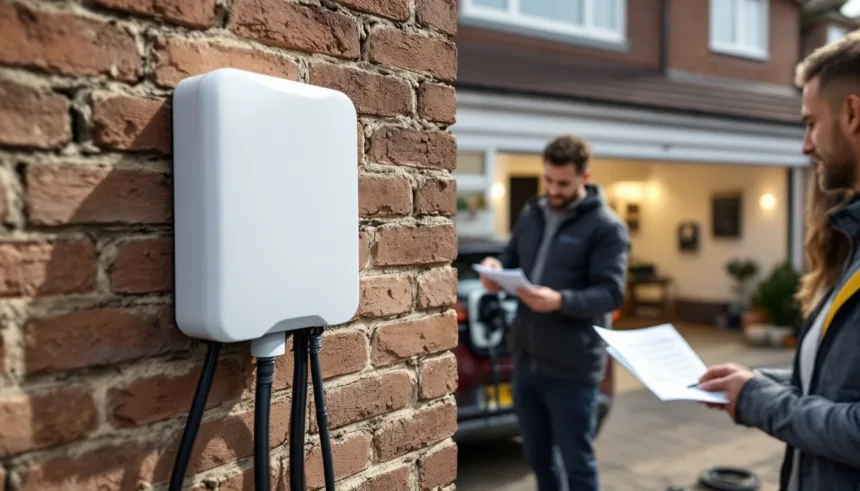
Most UK homeowners installing a 7 kW home EV charger in 2026 will pay between £800 and £1,300 all-in, though that figure can climb to £1,800 or more if your property needs a consumer-unit upgrade, long cable runs, or groundwork. Understanding EV charger installation cost UK 2026 means looking beyond the headline hardware price: electrician labour, certification, materials, and site-specific work often account for half the final invoice.
- EV charger installation cost UK 2026 at a glance
- Breaking down EV charger installation cost UK 2026 line by line
- How much electricians charge to fit a home EV charger
- Smart, solar and AI features that change the price
- Grants and incentives that cut your 2026 cost
- Home charger vs public charging: cost comparison
- Real 2026 cost examples for different UK homes
- How to get fair quotes and avoid surprise extras
- Frequently Asked Questions
This guide unpacks every cost component, hardware, installation labour, electrical upgrades, and available grants, then shows you real-world examples and practical steps to secure a fair quote and trim £200-£500 from the bill without sacrificing safety or smart features.
EV charger installation cost UK 2026 at a glance
For most homeowners, the EV charger installation cost UK 2026 sits around £900-£1,400 all-in for a standard 7 kW smart home charger, including VAT. That usually breaks down to roughly £500-£800 for the charger and £400-£600 for installation labour and materials when your fuse box is modern and close to the driveway.
Where things get expensive is when your electrics need work or the cable run is long. In 2026, complex installs typically land between £1,400-£2,200, once you add a new or upgraded consumer unit, long surface or buried cable runs, or extra civil works. Recent UK guides, such as carwow’s 2026 cost overview, point to broadly similar bands for hardware plus installation.
| Scenario 2026 | Hardware | Labour & materials | Typical total |
|---|---|---|---|
| Standard semi, short run | £500-£700 | £350-£500 | £850-£1,200 |
| Detached, 10-15 m run | £550-£800 | £450-£650 | £1,000-£1,450 |
| Older house, board upgrade | £550-£800 | £650-£1,000 | £1,200-£1,800 |
| Outbuilding or long trench | £600-£850 | £800-£1,300 | £1,400-£2,100 |
In a straightforward 2026 example, a terraced house with a modern consumer unit, 5-7 m of surface-run cable and Wi-Fi in range might pay ~£1,000: a mid-range smart charger at about £600 and a same-day install around £400. By contrast, a 1930s detached home needing a new consumer unit, 20 m of armoured cable around the side of the property and some remedial work could see the EV charger installation cost in the UK 2026 climb towards £1,800-£2,000, even before any optional extras like a small home battery or load-balancing accessories are added.
These ranges assume a 7 kW single-phase charger, which is the norm in UK homes. Three-phase 11-22 kW units, while less common domestically, generally push hardware up by £150-£400 and can add further labour cost if your incoming supply needs upgrading. Within those limits, a fair 2026 quote will usually fall somewhere in the middle of the bands above rather than at the very bottom or very top.
Related internal resource EV charger safety standards UK Germany.
Breaking down EV charger installation cost UK 2026 line by line
For a typical driveway home, the average EV charger installation cost UK 2026 is usually £900-£1,500 including VAT. That assumes a 7.4 kW smart charger, a standard wall run of up to 10 m, no major fuse-board upgrade, and a certified installer. Simpler jobs can land nearer £700-£800 after grants, while complex installs with long cable runs or consumer unit work can exceed £1,800.
The charger unit itself is normally 40-60% of the total. Basic untethered 7 kW models start around £350-£450 supplied, while better-known smart, app-controlled 7 kW chargers with load balancing and solar-ready features commonly sit at £550-£800. Faster 11-22 kW three-phase home units (where available) can reach £900-£1,200 before installation, so they push up the overall EV charger installation cost UK 2026 wherever the property has three-phase power.
| Cost item | Typical range | When it applies | Notes |
|---|---|---|---|
| Charger unit | £350-£1,200 | Every install | Power and features |
| Basic labour | £250-£450 | Standard jobs | Half to full day |
| Cable & parts | £80-£200 | All installs | Cable, glands, fixings |
| Board upgrades | £150-£500 | If board is dated | RCBO, new ways, SPD |
| Groundworks | £100-£600 | Long or hidden runs | Trenching or ducting |
Labour covers survey, fitting, testing and certification. For straightforward wall-mount installs near the consumer unit, many UK installers quote £250-£450 including testing paperwork. Longer runs, tricky routing, or two-person work at height will nudge that towards £500-£650. Installers also charge for materials such as 6-10 mm cable, junction boxes, clips, mini-trunking or conduit, isolator switches, and earth rods where the earthing system requires them; combined, these usually add £80-£200 depending on cable length and whether heavy-duty external containment is needed.
The biggest wildcards in EV charger installation cost UK 2026 are electrical upgrades and civil works. If your existing consumer unit has spare capacity and modern RCD / RCBO protection, you may only need a dedicated breaker (£40-£80 parts). If it is old, overloaded or lacks surge protection, expect £150-£500 for adding a small additional consumer unit, upgrading protection devices, or fitting load-shedding hardware. Where the driveway is far from the house, new ducting, trenching, or lifting and relaying paving can add £100-£600, particularly if a separate groundworker is involved.
Optional extras can nudge the total but may save money later. Load-balancing modules, essential for many homes with 60-80 A main fuses, typically add £70-£150. Solar and battery integration features can be built in or require an extra hub at £80-£200.
Related internal resource EV charger home battery combo worth it.
How much electricians charge to fit a home EV charger
For most homeowners, around half of the total EV charger installation cost in the UK 2026 is the electrician’s labour. For a straightforward domestic install, expect a qualified EV-experienced electrician to charge roughly £250-£450 in labour as part of a fixed-price package, or £45-£80 per hour if billed by time.
Many installers now offer fixed prices for a “standard install”. This typically covers: mounting the charger on an external wall near your consumer unit, up to 10-15 metres of surface-run cable, drilling through one wall, fitting an appropriate circuit breaker and RCD/RCBO, basic load assessment, and commissioning plus app setup. If your layout fits this template, their fixed labour portion is usually equivalent to 3-6 hours on site, plus some admin and certification time rolled in.
Extras are where labour can climb quickly. Common add-ons include longer cable runs, trenching for buried cable to a detached garage, upgrading or replacing a full consumer unit, fitting a separate small distribution board, or dealing with difficult cable routes in finished interiors. Each of these can add 1-4 hours of work, and potentially a second visit, pushing labour by another £100-£400 depending on complexity.
Region matters. London and the South East often sit at the top end of the ranges, with higher hourly rates and fewer installers willing to travel for small jobs. Northern England, Scotland, Wales and Northern Ireland often see lower hourly rates, but travel time may be baked into the quote for rural properties.
Smart, solar and AI features that change the price
Smart, solar and AI-enabled options can add £100-£600 to the upfront price of a home charger, but they can also cut running costs for years. When you compare quotes or research EV charger installation cost UK 2026, look beyond the box price and check how each feature will change when and how your car actually charges.
Smart home integration and dynamic-tariff control usually add a modest premium. Wi-Fi or 4G connectivity and an app are now common on mid-range units, but deeper integrations (for example, with Octopus Intelligent, British Gas PeakSave, or a home energy management system) often appear on £800-£1,200 installed packages instead of the £600-£800 basic range. In return, smart scheduling and demand-response tools can automatically shift most charging into off-peak periods, which may halve the cost per kWh on suitable tariffs. Over a few years of regular use, that saving can outweigh the initial uplift.
Solar-aware chargers cost more than standard models because they include extra electronics and firmware to track household generation. A typical quote might be £200-£400 higher for a unit that can prioritise surplus solar and throttle power to avoid importing from the grid. For homes exporting significant solar most days, this can materially reduce paid-for kWh, especially in spring and summer. However, if you only have a small PV array or limited daytime parking at home, the payback from a solar-optimised charger may be slow, so the cheaper smart-only option could be more rational.
Load management and home battery compatibility influence both equipment and labour. Chargers with built-in load balancing can monitor total house current draw and automatically reduce charge rate to protect the main fuse; that often avoids the need for a service fuse upgrade, which can otherwise add hundreds of pounds and weeks of delay.
Grants and incentives that cut your 2026 cost
For most homeowners, the fastest way to cut EV charger installation cost UK 2026 is to stack national grants with any local support. Rules have tightened compared with the early OLEV years, but flat owners, renters and landlords can still knock hundreds off a 7 kW smart charger install if they pick the right route and an authorised installer.
The main national help in 2026 comes via updated OZEV schemes (often still called the EV chargepoint grant). These focus on people who do not own a typical freehold house with a private driveway, plus landlords and businesses. A typical award can cover a substantial share of hardware and fitting when combined with a competitive quote, as outlined in this summary from carwow’s EV charger cost guide.
| Grant / scheme | Who it targets | Typical help | Key condition |
|---|---|---|---|
| EV chargepoint grant | Flat owners, renters | Up to ~75% of cost | Off-street parking, OZEV installer |
| Landlord grant | Landlords, social housing | Cap per socket & property | Residential or mixed-use sites |
| Workplace scheme | Employers, SMEs | Contribution per charger | Staff or fleet charging only |
| Local authority support | Households, small firms | Top-ups or fee waivers | Postcode and budget limited |
| Green finance offers | Homeowners | Low-rate loans or cashback | Via banks or energy firms |
To use these incentives effectively, first confirm eligibility: property type (flat vs house), parking (allocated off-street space), EV ownership or order, and whether you are owner, renter or landlord. Next, shortlist OZEV-approved installers and ask for itemised quotes that separate charger hardware, cabling, consumer unit work and labour. Installers usually submit the grant claim on your behalf, then invoice you only for the balance, making the real EV charger installation cost UK 2026 clearer before you commit.
Finally, check whether your council or devolved administration offers extra support, especially for flats and terraced streets, and compare this against any EV tariff or cashback deals from your energy supplier.
Home charger vs public charging: cost comparison
On 2026 tariffs, the typical EV charger installation cost UK 2026 homeowners face is roughly equal to one to two years of savings versus heavy reliance on public charging. The exact payback depends on your mileage and whether you can access cheap off-peak electricity, but in most realistic cases a 7 kW home unit plus installation will undercut rapid public networks by £400-£900 per year.
To keep comparisons grounded, assume a mid-size EV using about 0.28 kWh per mile and a UK driver covering 8,000-10,000 miles a year. For home charging, many suppliers now offer off-peak EV tariffs around 10-15p/kWh, while standard single-rate tariffs often sit nearer 25-30p/kWh. In contrast, common 50-150 kW public rapid chargers in 2026 are widely advertised in the 60-85p/kWh band; some motorway locations can be higher during peak times. These spreads mean the same annual mileage can cost well under half at home versus on the road.
| Scenario | Energy price | 8,000 miles/year | 10,000 miles/year |
|---|---|---|---|
| Home off-peak EV tariff | 12p/kWh | £270/year | £340/year |
| Home standard tariff | 28p/kWh | £630/year | £790/year |
| Mixed (70% home, 30% public) | Blended ~32p/kWh | £720/year | £900/year |
| Public rapid only | 72p/kWh | £1,640/year | £2,050/year |
Against that backdrop, a fully fitted 7 kW smart charger typically runs £900-£1,400 including VAT in 2026, based on round-ups like this UK cost guide. A driver doing 10,000 miles a year and switching from almost all-public rapid use to mainly home off-peak could save about £1,700 a year in energy alone. Even a more modest shift from public to a mix of home and public could still free up £500-£800 annually, which effectively “repays” the charger within a couple of years.
Beyond the core price-per-kWh gap, home charging also reduces time spent waiting at public points, lowers the risk of queueing or broken units, and gives consistent overnight charging at known costs.
Real 2026 cost examples for different UK homes
Installation costs vary sharply by property layout, electrical infrastructure, and parking arrangement. Below are three typical UK scenarios with realistic 2026 line-item breakdowns drawn from installer quotes.
Semi-detached house with driveway (5 m from consumer unit): The most straightforward case. A 7.4 kW tethered charger mounted on the garage wall costs £450-£650 for the unit. Labour and materials, cable, conduit, isolator switch, and earthing upgrades, add £350-£500. Total outlay: £800-£1,150. If your consumer unit is modern (post-2018) and has a spare 40 A breaker, no board upgrade is needed. Older fuse boxes may require a £200-£400 board replacement, pushing the total to £1,000-£1,550.
For a flat with allocated parking 15 m from the meter cupboard, expect higher cable and labour costs. A 7 kW untethered unit (£400-£600) plus extended armoured cable, trunking, and communal-area permissions lifts installation to £600-£850. Combined cost: £1,000-£1,450. Leasehold properties often require freeholder consent and a Part P electrical certificate, adding £100-£150 in admin and inspection fees.
Rural detached home with 25 m cable run: Long distances from the distribution board to the parking area drive up material and labour. A 7.4 kW smart charger (£500-£700) plus 25 m of 10 mm² armoured cable, groundworks for buried conduit, and a dedicated RCD incubator cost £800-£1,200 in installation. Total: £1,300-£1,900. Properties on single-phase supplies above 7 kW may need a Distribution Network Operator (DNO) notification, which is free but adds two weeks to the timeline.
Each scenario assumes a standard installation by an OZEV-approved installer. Complex jobs, three-phase upgrades, listed buildings, or shared supply arrangements, can add £300-£800. Always request itemised quotes covering unit, labour, materials, certification, and any board or DNO work to compare fairly and spot hidden fees.
How to get fair quotes and avoid surprise extras
To get fair EV charger installation quotes in the UK, start by gathering the information installers always ask for. That way you can compare like-for-like prices and avoid “site survey” surprises that add hundreds to the EV charger installation cost later.
Before you contact anyone, walk the route from your consumer unit (fuse box) to where you want the charger. Measure the cable run length (follow walls and corners, not straight lines) and note wall types (brick, block, stud), any obstacles, and whether you’ll need trenching outside. Take clear photos of:
- Consumer unit close-up with labels and spare ways visible
- Main incoming supply, meter, and any existing isolator switch
- Preferred charger location from a few angles
- Driveway/parking area and cable route (inside and out)
When you email or message installers, include: your EV model, desired charger power (7 kW is standard), whether you want tethered/untethered, Wi-Fi access quality, off-street parking details, and if you have (or plan) solar or a home battery. Ask for a written quote that itemises: charger unit, standard installation scope, maximum cable length included, labour, any extra materials, DNO notification or application, and VAT. Request that they list potential extras separately (e.g. consumer unit upgrade, earth rod, groundworks, drilling through thick stone walls).
Use these questions to benchmark installers: Are you OZEV-approved? Is this a fixed quote or an estimate? What counts as “non-standard” and what are your typical extra charges per metre of cable and per hole drilled?
Frequently Asked Questions
How much does an electrician charge to install an EV charger in the UK?
For a typical 7kW home charger in 2026, UK labour for installation usually sits around £250-£450 within a fixed-fee package of £900-£1,200 including hardware. That normally covers up to 10-15m of cabling, drilling, basic testing and paperwork.
Can I get a free EV home charger?
Genuinely free EV home chargers were more common under older schemes; in 2026 you’ll usually pay something, but the net EV charger installation cost in the UK can be very low with OZEV grants and manufacturer or energy-supplier bundles.
Can a normal electrician fit an EV charger?
Any competent electrician can physically wire a charger, but for grants you must use an OZEV-approved installer. They should be familiar with Part P, the IET Wiring Regulations and EV chargepoint standards.
What is the cheapest EV home charger with installation in the UK?
In 2026, the lowest realistic all-in price for a safe, 7kW smart charger with standard installation is typically £700-£850 after any grant, depending on region and cable run. Budget options often use lesser-known brands, basic apps and shorter warranties.
Which is better, a 3kW or 7kW home charger?
A 3kW charger is cheaper and may suit very low-mileage drivers, but it can take 20-24 hours to fill a large battery from empty. A 7kW home charger usually adds 25-30 miles of range per charging hour and comfortably refills most EVs overnight.
EV charger installation cost in the UK for 2026 is predictable once you know your property’s electrical baseline and the charger features you need. Budget £800-£1,300 for a straightforward install, add a buffer for upgrades, and apply for any available grant before you book.
Get three itemised quotes, confirm MCS or OZEV certification, and prioritise safety over the cheapest headline price. With the right preparation, you’ll have a compliant, future-proof home charging setup that pays for itself in convenience and lower running costs within the first year of ownership.