



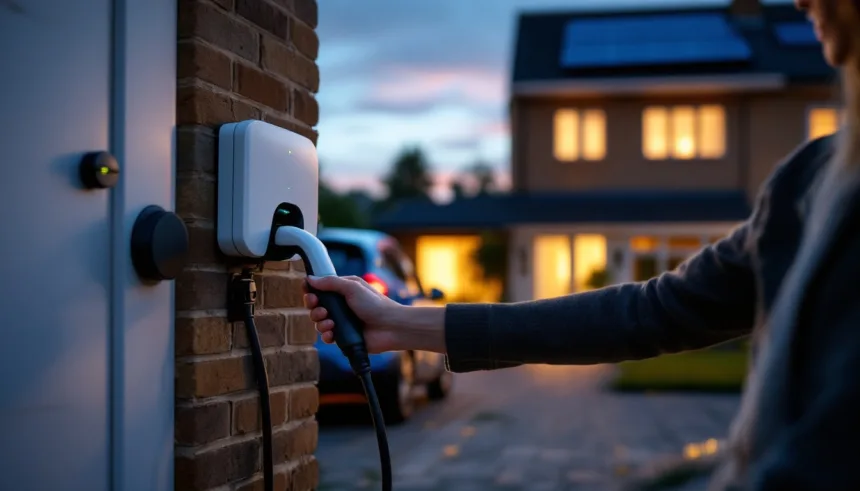
Finding the cheapest EV charging tariff UK households can access in 2026 means looking beyond headline pence-per-kWh rates and understanding how your actual driving pattern, home electricity use, and charging setup interact with time-of-use pricing. The lowest overnight rates now sit between 4p and 7p per kWh during off-peak windows, roughly a quarter of standard daytime prices, but those savings only materialise if you charge during the right hours and your whole-house consumption doesn’t spike your average cost.
- What is the cheapest EV charging tariff UK?
- Cheapest EV Charging Tariff UK
- Current examples of the cheapest EV tariffs
- Comparing tariff types for home EV charging
- How to work out your cheapest EV tariff
- Using AI and smart charging to cut costs
- Cheapest home tariffs vs public charging costs
- If you split time between the UK and Germany
- Frequently Asked Questions
This guide walks through what “cheap” really means for different driver profiles, compares the leading off-peak and smart EV tariffs available today, and shows you step-by-step how to calculate your true cost per mile, check whether a dedicated EV tariff beats your current deal, and stack additional savings with solar panels, home batteries, and intelligent chargers that automatically hunt the lowest rates.
What is the cheapest EV charging tariff UK?
In 2026, the cheapest EV charging tariff UK typically means paying around 4-10p per kWh off-peak, versus roughly 28-35p per kWh on a standard single-rate tariff. Anything consistently under about 12p/kWh for several night-time hours is in genuinely cheap territory; rates above that are closer to “slightly discounted” than truly low-cost.
These ultra-low prices usually come from specialist EV tariffs and smart / dynamic tariffs rather than from your supplier’s basic plan. Suppliers often reserve their very lowest unit rates for a short off-peak window (for example, 4-6 hours overnight) and charge a higher-than-standard rate during the day to compensate. That structure is why headline prices can look amazing while whole-house savings vary a lot.
Standard flat-rate electricity in the UK in 2026 commonly lands in the high-20s to mid-30s pence per kWh, depending on region and standing charge. On that basis, dropping your charging to 5-10p/kWh off-peak cuts the per-mile cost of driving by around two-thirds or more compared with charging at daytime standard rates, and by much more compared with public rapid charging.
For a typical UK driver covering about 8,000-10,000 miles per year in an efficient EV (around 3-4 miles per kWh):
- On a standard tariff at ~30p/kWh, home charging might cost roughly £600-£1,000 per year.
- On a good off-peak EV tariff at 5-10p/kWh, that drops to around £200-£350 for the same mileage.
That gives a realistic saving band of roughly £300-£650 per year on charging alone, before considering any impact on your daytime household consumption or standing charges.
However, what counts as the cheapest EV charging tariff UK for you personally depends on three things: when you can charge, how many miles you drive, and how much non-EV electricity your home uses. Heavy drivers who can reliably plug in overnight benefit most from very low off-peak rates, even if their daytime rate is slightly higher. Light drivers or people who are home all day using lots of electricity may be better with a simpler, moderately cheap off-peak window or even a competitive flat-rate tariff that doesn’t punish daytime use.
Related internal resource EV charger installation cost UK 2026.
Cheapest EV Charging Tariff UK
The cheapest EV charging tariff UK deals use time-of-use pricing: electricity is split into cheap off-peak hours (usually overnight) and more expensive daytime rates. Instead of paying one flat price per kWh, you get a very low rate for a few set hours to charge your car, sometimes 50-70% below the supplier’s standard unit rate.
There are two main structures. First, general time-of-use tariffs (often called “smart” or “off-peak” tariffs) where the cheap rate applies to all household use in the off-peak window, not just your EV. Second, EV-only or EV-focused tariffs, where very low prices are targeted at night and are explicitly designed around home charging behaviour. Both usually require a smart meter so your supplier can see when you use electricity and bill the right rate.
Many of the cheapest EV charging tariff UK options layer on smart or AI-controlled charging. You set when the car must be ready and the system automatically schedules charging into the cheapest half-hours, adjusting if wholesale prices or grid conditions change. This can squeeze more kWh into ultra-cheap periods than you’d manage manually, and some tariffs even vary the off-peak price daily based on market rates.
The trade-off is that these tariffs often push up the day rate and, sometimes, the standing charge. If you work from home, use electric heating, or run power-hungry appliances in the day, the savings from cheap EV charging can be eaten by higher whole-house costs. You also need enough flexibility in when the car is plugged in to take advantage of the off-peak window; if you mostly charge at 6-8pm, a smart EV tariff is unlikely to win. Before switching, it’s worth modelling your annual usage pattern with an EV tariff calculator or comparison, such as the guidance on MoneySavingExpert’s EV energy tariffs page, to see whether an EV-specific deal truly beats the best standard fixed or variable tariff for your household.
Related internal resource EV charger safety standards UK Germany.
Current examples of the cheapest EV tariffs
In early 2026, the cheapest EV charging tariff UK drivers can usually get is a specialist off-peak or smart EV tariff, not a flat-rate standard deal. Exact prices move with wholesale markets, but most of the best offers fall into clear bands: very cheap night rates, higher daytime rates, and a separate standing charge.
Below is an indicative snapshot of how leading cheap EV tariffs are structured. Figures are rounded and anonymised, based on typical patterns from major suppliers and public guides such as MoneySavingExpert’s EV tariffs overview.
| Tariff type | Off-peak rate | Off-peak hours | Standing charge |
|---|---|---|---|
| Ultra-cheap night | 5-7p/kWh | 6-7 hours | 45-60p/day |
| Smart dynamic | 4-9p/kWh | Varies nightly | 50-70p/day |
| Standard EV | 9-14p/kWh | 4-6 hours | 45-60p/day |
| Flat-rate fixed | 22-30p/kWh | 24 hours | 50-70p/day |
With these structures, the cheapest EV charging tariff UK households access is often not the overall cheapest for total home energy. Daytime unit rates on EV tariffs can be higher than on mainstream fixed deals, so you need to check whole-house cost, not just the night rate for the car.
To show how this plays out, here are simplified monthly bill examples comparing a typical EV tariff (8p/kWh off-peak, 30p/kWh day, 55p/day standing charge) with a standard flat-rate tariff (26p/kWh all day, 60p/day standing charge). All examples assume 60% of EV charging is shifted into the cheap window using a smart charger or the supplier’s app.
1) Light driver, about 300 EV miles/month
Assume 3 miles/kWh, so 100kWh/month into the car.
• Standard tariff: 100kWh × 26p = £26
• EV tariff: 60kWh off-peak × 8p (£4.80) + 40kWh day × 30p (£12) = £16.80
Fuel saving on the EV portion is ~£9/month before standing charges. If the household’s general daytime use is high, that extra 4-5p/day on the standing charge plus any higher day rate can eat into this; light drivers should compare total annual cost carefully.
2) Average driver, about 800 EV miles/month Energy use is roughly 267kWh/month. • Standard tariff: 267kWh × 26p ≈ £69.42 • EV tariff: 160kWh off-peak × 8p (£12.80) + 107kWh day × 30p (£32.10) ≈ £44.90 This driver saves about £24-£25/month on car charging alone.
Comparing tariff types for home EV charging
To find the cheapest EV charging tariff UK drivers can realistically use, you need to understand how four main tariff types behave: standard flat, Economy 7/dual-rate, specialist EV tariffs, and fully dynamic smart tariffs. The right choice depends on how many miles you drive, when your household uses power, and whether you can shift big loads like washing and hot water into off-peak windows.
| Tariff type | Typical unit price | Best for | Main risk |
|---|---|---|---|
| Standard flat | Same 24/7 | Very low mileage | No cheap night rate |
| Economy 7 | Cheap night, pricey day | Night owls, storage | Higher daytime cost |
| EV time-of-use | Very cheap set hours | Most daily drivers | Limited cheap window |
| Dynamic smart | Half-hour changing | Flexible, tech-savvy | Complex and volatile |
Standard flat tariffs now rarely deliver the lowest cost per mile. They can still suit light-use drivers doing under about 3,000-4,000 miles a year who charge mostly at public networks or work, because a simple flat rate avoids paying a premium day rate you’ll never compensate with off-peak charging. For anyone charging at home weekly, a flat tariff usually leaves 20-50% savings on the table compared with a tailored EV time-of-use deal.
Economy 7 or dual-rate tariffs give around 7 off-peak hours overnight and a more expensive day rate. They tend to work if you already have night-heavy usage (storage heaters, immersion tank, dishwasher, tumble dryer) and can set your EV to charge entirely in that window. For moderate drivers and busy households who can’t avoid daytime usage, the higher peak rate can quietly erase a chunk of the headline EV saving, so effective whole-house cost per mile may be worse than a modern EV-specific tariff.
Dedicated EV time-of-use tariffs usually offer a very low fixed night rate for 4-6 hours, often cheaper than Economy 7, with a more competitive daytime rate. For most drivers doing 5,000-10,000 miles a year and charging 2-4 nights a week, these are typically the cheapest EV charging tariff UK suppliers offer on a predictable basis. You set your car or smart charger to only pull power in the cheap window; as long as you avoid big appliances then, you keep the saving focused on the car without blowing up daytime bills.
How to work out your cheapest EV tariff
To find the cheapest EV charging tariff UK drivers can realistically use, you need a quick set of numbers about your driving, your car and your home. Once you have those, you can plug them into any supplier calculator or comparison site in a few minutes and see which smart EV charging tariffs really save you money.
Start with how much energy you actually need each week:
- Note your typical weekly mileage over the last month.
- Check your car’s efficiency (kWh per mile) from the dashboard or the manufacturer’s figure for kWh/100 miles.
- Use: Weekly kWh = Weekly miles × kWh per mile. For example, 200 miles × 0.27 kWh = 54 kWh.
- Decide what fraction of that charging you can do at home (e.g. 80% if you also use workplace or public chargers).
Next, work out how easily you can keep charging inside off-peak windows on a smart EV charging tariff. List your cheap-rate hours (for example, 23:30-05:30) from each supplier’s tariff page. Then:
- Check your home charger’s max power (e.g. 7.4 kW)
- Estimate: Off-peak kWh per night = Charger kW × Off-peak hours you’ll actually use
- Multiply by 7 to get a realistic weekly off-peak kWh limit
If your weekly kWh need is lower than your weekly off-peak capacity, you can assume nearly all home charging will land on the cheap rate with a smart charger or supplier app. If it’s higher, you’ll need to allow for some peak-rate top-ups when comparing tariffs.
Now factor in the rest of your household usage so the cheapest EV charging tariff UK comparison doesn’t accidentally raise your total bill. Grab your latest 12 months of bills or your smart meter app and:
- Find your annual kWh usage without the car, then divide by 12 for a monthly figure.
- Look at the hourly or daily breakdown if you have one and estimate what share of that happens in the planned off-peak window (e.g. 25% if you can run washing machines, dishwashers and immersion heating overnight).
- Separate your usage into: day kWh (standard rate) and night/off-peak kWh.
- Note unit rates and hours: standard p/kWh, off-peak p/kWh, standing charge and exact cheap-rate times.
- Estimate annual EV cost: (EV off-peak kWh × off-peak rate) + (EV peak kWh × day rate).
- Estimate annual home cost: (Home off-peak kWh × off-peak rate) + (Home day kWh × day rate).
- Add standing charge for the year: Standing charge (p/day) × 365 ÷ 100 to convert to pounds.
- Sum EV + home + standing charge to get an annual total for that tariff.
Using AI and smart charging to cut costs
AI-driven smart charging is what turns a good off-peak deal into something close to the cheapest EV charging tariff UK for your real usage, not just on paper. Instead of you guessing when to plug in, the charger or supplier app looks at your EV’s battery level, your next departure time, your tariff’s half-hourly prices, and sometimes even your solar output, then automatically chooses the lowest-cost slots to hit your target charge.
Most smart EV chargers and energy-supplier apps work roughly the same way. You tell them when you need the car ready and what percentage you want (for example 80% to limit battery wear). The system then:
- Reads your current state of charge from the car or cable
- Calculates how many kWh are needed to reach the target
- Scans upcoming half-hour blocks for the cheapest prices
- Schedules just enough charging in those blocks to finish on time
- Pauses or slows charging if prices spike or solar output changes
This is especially powerful on dynamic or multi-rate tariffs. A smart charger can chase ultra-cheap 2-5 am windows while avoiding the early-evening peak, without you touching a timer. Because it only charges as much as you actually need, you avoid wasting cheap-rate hours on an already-full battery. Setting an 80% cap also supports long-term battery health by avoiding constant high-voltage top-ups.
When linked with solar PV or a home battery, AI scheduling can prioritise free or stored energy first, then use the tariff’s off-peak periods to top up what’s left. For example, imagine a 60 kWh EV arrives home at 30% (18 kWh in the pack) at 18:30, and you want 80% (48 kWh) by 07:00. That’s 30 kWh needed.
Cheapest home tariffs vs public charging costs
On the cheapest EV charging tariff UK drivers can currently get, overnight off-peak rates often land around 7-12p/kWh. By contrast, UK rapid public chargers typically sit in the 55-75p/kWh band, and ultra-rapids can be higher, even after subscriptions. That gap is what makes a smart home EV tariff so powerful if you can reliably charge at home.
| Charging type | Typical price | Cost per 200 miles* | Notes |
|---|---|---|---|
| Smart home off-peak | 7-12p/kWh | £3-£6 | Timed overnight |
| Standard home tariff | 24-30p/kWh | £10-£15 | Flat-rate |
| Public fast (7-22kW) | 40-55p/kWh | £16-£22 | Car parks, workplaces |
| Public rapid (50kW) | 55-70p/kWh | £22-£28 | Motorways, A-roads |
| Ultra-rapid (100kW+) | 65-85p/kWh | £26-£34 | Long-distance focus |
*Assumes 3.5 miles/kWh. Real costs vary by car and driving style.
For a typical UK driver doing 8,000-10,000 miles per year, a smart EV tariff can save roughly £600-£900 annually versus relying mainly on public rapid charging, even after paying any home-charger finance and standing charges. Once you’re above about 4,000-5,000 miles per year and can do most charging at home, a dedicated off-peak EV tariff usually wins clearly on cost per mile.
Public charging can still dominate in specific patterns: very low mileage (under ~3,000 miles a year), no off-street parking, or if work or local public points are consistently cheap or subsidised. In those cases, tying yourself to the absolute cheapest EV charging tariff UK suppliers advertise may add complexity without meaningful savings, so it’s worth running the numbers for your own annual mileage and access before switching.
If you split time between the UK and Germany
If you move between the UK and Germany, you’ll notice that the idea of hunting for the cheapest EV charging tariff UK style (dedicated off-peak EV electricity rate at home) often doesn’t translate directly to Germany. In Britain, several suppliers now sell EV-specific or dynamic tariffs with very cheap night prices and clear peak/off-peak windows. In Germany, you’re more likely to see standard household tariffs, dynamic spot-price offers linked to the power exchange, and less separation between “EV” and “non-EV” pricing, though regional and supplier differences are large.
In the UK, the main decision is typically between a flat household tariff, a dual-rate (day/night) tariff, or a smart EV tariff that uses automation to charge when prices are low. In Germany, you may have one general tariff for all usage, possibly with time-varying or spot-linked pricing. That makes whole-house behaviour even more important: an EV session during a high grid-price hour can be expensive, while flexible overnight charging can still be very cheap, but you usually need a smart charger or automation that talks to a dynamic tariff.
Think about home versus workplace versus public charging differently in each country.
Frequently Asked Questions
What is the cheapest EV charging tariff in the UK?
The cheapest EV charging tariff UK drivers can usually get is a smart or EV-specific off-peak deal with very low night rates, often around 5-12p/kWh, versus 25-40p/kWh daytime. Exact “cheapest” tariffs change regularly, so focus on total annual cost for your usage pattern, not just the single lowest p/kWh headline rate.
What is the cheapest tariff for EV charging in the UK?
There is no single permanently cheapest EV charging tariff in the UK. To find today’s best option, estimate your monthly kWh for home charging, plug this into EV-specific comparison tools, and compare total annual cost.
Watch for tricks like ultra-cheap 2-3-hour windows paired with very high daytime or standing charges.
Which supplier has the cheapest EV tariff?
No supplier consistently offers the cheapest EV tariff; rankings shift month-to-month. Check reputable comparison sites plus suppliers’ own EV pages for current deals.
Beyond unit price, weigh standing charge, off-peak window length, exit fees, smart meter or hardware requirements, and how the tariff affects your whole-house electricity costs.
What is the cheapest time of day to charge your electric car?
On most cheapest EV charging tariff UK options, the lowest-cost time is late night to early morning, commonly somewhere between 11pm and 7am. Confirm your exact off-peak hours on the tariff’s rate sheet.
What is the cheapest EV charging station in the UK?
For homeowners, the cheapest “EV charging station” is almost always your own home charger on a well-chosen off-peak or smart EV tariff, not public rapid chargers.
Securing the cheapest EV charging tariff UK suppliers offer requires matching your charging window to the tariff’s off-peak hours, calculating whole-house impact rather than car-only costs, and revisiting your choice every twelve months as new products launch and your mileage changes. Start by logging one week of actual charging times and home usage, compare at least three tariffs using your real numbers, and factor in any exit fees or minimum terms before switching.
If you already have solar or plan to add a battery, model those flows separately, the interaction can flip which tariff saves most.