



Home EV charging uses your household electricity supply and a dedicated charge point to refill your car’s battery while it’s parked overnight or during the day. For most UK and German homeowners, this means installing a wall-mounted AC charger that draws power from your home’s electrical system, converts it to the right voltage, and feeds it safely into your vehicle.
- How does home EV charging work day to day?
- How Does Home EV Charging Work
- Charging speeds, power ratings and real range
- What home EV charging really costs
- Smart chargers, AI and home energy control
- Installation, safety and local regulations
- Home charging vs public charging compared
- Frequently Asked Questions
Understanding how does home EV charging work comes down to three practical elements: the equipment you install, the electrical infrastructure that supports it, and the charging speeds and costs you can expect in real-world use. This guide walks through the basics of AC charging at home, explains what happens behind the scenes when you plug in, covers the wiring and safety requirements, and shows how smart chargers, off-peak tariffs, and home batteries can reduce costs and carbon.
How does home EV charging work day to day?
When people ask “how does home EV charging work?”, they’re really asking what happens between your house wiring and your car’s battery. In a typical UK or German home, your charger takes normal AC power from your mains, sends it through a dedicated cable or wallbox, and your car’s onboard charger converts that AC into DC to store in the battery. You’re using the same electricity that runs your lights and appliances, just at a higher, controlled load.
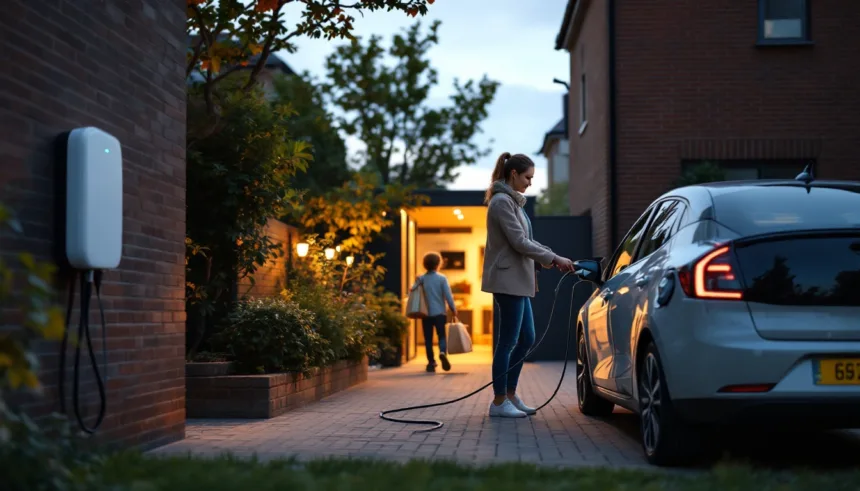
Day to day, your routine is simple. You park, plug the cable into the car and the charger, and the car and charger “handshake” to agree a safe current and speed. Charging then runs either immediately or at the time you’ve set in the car app or charger app. In the morning, you unplug and drive away; there’s no need to “top off” like petrol, because the system automatically stops when the battery reaches the set limit.
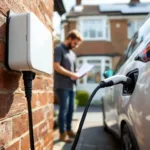
Behind the scenes, the wallbox or smart socket constantly monitors temperature, current and any faults. If there’s an issue, it shuts off power in milliseconds using built-in safety relays and your home’s circuit protection.
How Does Home EV Charging Work
At its core, how does home EV charging work? Your car’s onboard charger pulls AC power from your house, through a dedicated circuit and charge point, and converts it into DC to fill the battery. Safe, consistent charging in UK and German homes depends on having the right wallbox, wiring, and protection devices matched to your supply.
The simplest option is a portable “granny charger” (Mode 2 cable) that plugs into a normal domestic socket. In both the UK (230 V, single phase) and Germany (230 V) this is usually limited to about 2.3-3.0 kW, adding roughly 10-15 km of range per hour and suited only to occasional or low-mileage use because it loads a standard socket for many hours.
Most owners install a fixed wallbox (Mode 3). In UK houses with single-phase supplies, typical ratings are 3.6 kW (16 A) and 7.4 kW (32 A). In Germany, many homes have three-phase; common chargers are 3.7 kW single-phase or 11 kW three-phase. An 11 kW unit can roughly triple charging speed versus 3.7 kW, but only if both the home supply and the car’s onboard charger support three-phase.

The wallbox must be on its own dedicated circuit from the consumer unit/fuse box, sized for the current and cable run.
Charging speeds, power ratings and real range
Home EV charging work is mostly about power in (kW) versus energy stored (kWh). A charger’s power rating tells you how quickly it can move energy into the battery; the battery size (kWh) and your starting state of charge (SoC) then decide how long a full or partial charge takes. Roughly, hours to charge ≈ energy added (kWh) ÷ charger power (kW). Because EVs slow down charging above ~80% to protect the battery, the last 20% often takes longer than the first 60-70%.
In the UK, most home wallboxes are single-phase 7.4 kW units on a 230 V supply; in Germany, many homes support 11 kW three-phase AC charging. Both usually give plenty of overnight range for daily use. A larger battery (e.g. 77 kWh) simply needs more hours than a smaller one (e.g. 50 kWh) on the same charger, but the relationship is linear until the taper at higher SoC.
As a simple rule of thumb, you can think in miles or kilometres of range gained per hour of charging. Actual numbers depend on your car’s efficiency and weather, but the ranges below cover typical family EVs used in UK and German conditions.
| Charger type | Power | Miles/hour | Km/hour |
|---|---|---|---|
| 3-pin plug (UK) | ~2.3 kW | 6-8 | 10-13 |
| 3.6 kW wallbox | 3.6 kW | 10-15 | 16-24 |
| 7.4 kW wallbox (UK) | 7.4 kW | 20-30 | 32-48 |
| 11 kW wallbox (DE) | 11 kW | 30-40 | 48-64 |
What home EV charging really costs
Home EV charging costs are driven by one thing: the price you pay per kWh on your electricity tariff. To estimate a full charge, multiply your battery size by your unit rate. For example, a 60 kWh battery on a £0.30/kWh tariff costs about £18 for 0-100%, though you rarely charge from empty. The same logic applies for German prices in €/kWh.
To compare running costs with petrol or diesel, work out cost per 100 km. First, note your car’s average consumption (for many EVs, 16-20 kWh/100 km). Then use: cost per 100 km = (consumption in kWh/100 km) × (tariff in £/€ per kWh). If your EV averages 18 kWh/100 km and you pay £0.30/kWh, that’s about £5.40 per 100 km.
| Country | Tariff type | Example price | Cost /100 km* |
|---|---|---|---|
| UK | Standard | £0.30/kWh | £5.40 |
| UK | Off-peak EV | £0.10/kWh | £1.80 |
| Germany | Standard | €0.35/kWh | €6.30 |
| Germany | Off-peak | €0.22/kWh | €3.96 |
| UK/DE | Public rapid | £0.55-0.70 | High vs home |
*Assuming 18 kWh/100 km consumption.
In the UK and Germany, suppliers increasingly offer off-peak or EV-specific tariffs, with much cheaper rates overnight when demand is lower. A smart home charger can automatically schedule charging during these hours so you avoid peak prices without thinking about it.
Smart chargers, AI and home energy control
Modern smart EV chargers sit between your car and the grid, constantly measuring how much power your home is using and deciding when and how fast to charge. Instead of pushing full power as soon as you plug in, a smart charger talks to an app or cloud service to schedule charging, limit current and shift most charging into cheap or low-carbon hours. That’s the core of how home EV charging works in a smart setup, whether you are in the UK or Germany.
Load management is the first building block. The charger monitors total household demand and automatically turns itself down if ovens, showers or heat pumps push usage towards your main fuse limit (for example 60-100 A single-phase in many UK homes, and up to 3-phase 63 A in Germany). This avoids nuisance fuse trips and can remove the need for an expensive service upgrade. Some chargers coordinate multiple vehicles so that two cars share available amps without overloading the supply.
Smart and AI-driven apps add optimisation on top of this safety layer. They pull in time-of-use tariffs, day-ahead price forecasts and grid carbon data to decide the cheapest or cleanest hours to charge before your next departure.
Installation, safety and local regulations
For both the UK and Germany, a home EV charging point is legally treated as a high-load electrical installation, so it must be designed and fitted by a qualified electrician. They size the supply cable, check the main fuse and earthing, and confirm your incoming supply (single or three phase) can handle continuous charging without tripping or overheating.
Modern wallboxes need dedicated circuits with overload and fault protection. Typical measures include a correctly rated MCB, RCD or RCBO, and often DC leakage protection either built into the charger or in the distribution board. In the UK, installers follow BS 7671 and EV-specific guidance, including rules around PME earthing to prevent dangerous touch voltages. In Germany, work must comply with VDE standards and local grid operator requirements.
Utility notification is usually mandatory. In the UK, most domestic chargers up to 7.4 kW are installed under “connect and notify” with your Distribution Network Operator; higher loads or multiple chargers may need prior approval or an export/import limit. In Germany, the grid operator (Netzbetreiber) normally must be notified, and powerful wallboxes (often from 11 kW upward) require explicit permission and may need load management.
Home charging vs public charging compared
Home EV charging is almost always AC, using a 7-11 kW wallbox on a dedicated circuit. Public chargers add both slower AC posts (often 7-22 kW) and DC rapid or ultra-rapid units from 50 kW up to 350 kW. Understanding how home EV charging works alongside these faster public options helps you choose the right mix for daily use and long trips.
| Feature | Home AC | Workplace AC | Public DC rapid |
|---|---|---|---|
| Typical power | 7-11 kW | 7-22 kW | 50-350 kW |
| Time 0-80% | 4-10 hours | 3-8 hours | 15-60 minutes |
| Cost per kWh | Usually lowest | Often subsidised | Highest |
| Convenience | Plug in overnight | Charge while working | Detour and wait |
| Battery stress | Gentle, best long-term | Gentle to moderate | Higher heat and wear |
At home, AC charging uses the car’s onboard charger to convert AC to DC and fill the battery gradually. This slower, steady charging is kinder to the battery, easier on your household wiring, and usually cheapest, especially when paired with off-peak tariffs or solar. Workplace AC is similar, just shifted to daytime and employer facilities.
Public DC rapid chargers bypass most of the car’s onboard charger and feed high-power DC directly to the battery.
Authoritative resource: 6 burning questions about electric car home chargers ….
Frequently Asked Questions
How does EV charging work at home?
Home EV charging works by turning AC power from your house into DC power for the battery. A socket or wallbox supplies AC to the car’s onboard charger, which converts it and manages battery safety.
Which is better, a 3kW or 7kW home charger?
A 3 kW home charger adds about 10-15 miles (16-24 km) of range per hour, so an overnight 10-hour charge suits low daily mileage in UK and German homes. A 7 kW unit adds roughly 25-30 miles (40-50 km) per hour, ideal if you drive more, arrive home late, or want flexibility.
Should I charge my EV to 100% every night?
Most EV makers suggest daily charging to around 70-80% for battery health, not 100%. Save full charges for long trips or when you need maximum range, and unplug or drive soon after.
What can go wrong with a home EV charger?
Issues can include wiring faults, tripping RCDs or breakers, loose or overheating sockets, damaged cables, poor earth connection, and software glitches in smart chargers or apps. Keep vents and connectors clean, avoid extension leads, update firmware, and watch for hot plugs or burning smells.
What is the 80 20 rule in EV charging?
The 80/20 rule means ideally keeping your battery between about 20% and 80% state of charge for everyday use, which typically supports better long-term battery health.
Home EV charging works by drawing AC power from your household supply, routing it through a dedicated charge point, and letting your car’s onboard charger convert it to DC for the battery. For UK and German homeowners, a 7 kW wall box on an off-peak tariff delivers practical overnight charging at the lowest cost, while smart scheduling and solar integration can cut bills further.
Once you understand how does home EV charging work in practice, equipment, wiring, speeds, and tariffs, you can set up a system that fits your driving routine, budget, and grid connection without overcomplicating the process.