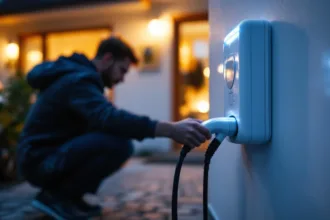





A smart thermostat AI is a Wi-Fi-connected heating controller that replaces your traditional wall thermostat and uses algorithms to learn your schedule, predict when you’ll be home, and automatically adjust your boiler or heat pump to maintain comfort while cutting energy waste. Unlike a classic programmable thermostat that follows a fixed timetable you set once, a smart thermostat continuously adapts based on occupancy patterns, outdoor weather, and how quickly your home heats or cools.
- What is a smart thermostat AI?
- How a smart thermostat AI actually works
- Smart thermostat AI vs regular thermostats
- Energy savings you can realistically expect
- Key smart thermostat AI features explained
- How it fits UK and German heating systems
- Installing and using a smart thermostat AI
- Is a smart thermostat AI right for you?
- Frequently Asked Questions
For UK and German homeowners facing rising energy costs and stricter efficiency standards, understanding what a smart thermostat AI actually does, and what it can’t do, is essential before investing £150-£300 in hardware and installation. This guide explains in plain terms how smart thermostat AI works with common European heating systems, what data and machine learning techniques power the automation, and how to evaluate whether the promised savings and convenience justify the upfront cost in your specific home.
What is a smart thermostat AI?
In simple terms, when people ask “what is a smart thermostat AI?”, they mean a heating controller that connects to the internet, can be managed from a phone, and uses software to learn how and when to heat your home. In UK and German homes, this usually replaces or works alongside the wall thermostat that talks to your gas boiler, heat pump, or electric radiators.
The “smart” part comes from Wi-Fi and an app. You can change the temperature from your smartphone, create schedules room by room, see if the heating is on while you are away, and sometimes link it to other devices such as smart TRVs (radiator valves) or window sensors.

The “AI” layer is software that looks for patterns in your behaviour and your building. Over time, it can learn when you are typically home, how quickly your flat or house warms up and cools down, and even react to local weather data. It then adjusts start and stop times, pre-heats before you wake up, or turns the system down earlier if rooms stay warm.
How a smart thermostat AI actually works
To understand what is a smart thermostat AI in practice, it helps to follow what happens over a typical day. The device constantly collects data, learns patterns over a few weeks, then sends control signals to your boiler or heat pump to hit your comfort level with less wasted energy.
First, sensors take in raw data: indoor temperature in each zone, humidity, and sometimes whether someone is home (via motion sensors, phone location, or schedules). Many models also pull in outdoor weather forecasts, time-of-use electricity tariffs, and in some cases boiler or heat pump status data from the control bus.
Next, the smart thermostat AI runs simple machine-learning style routines on this stream of information. It spots repeated patterns: what temperature you prefer at 7:00 on weekdays, how quickly each room in a UK or German home warms up, and how outside temperature affects heat loss. Over 1-3 weeks, it builds a prediction of how long the heating must run in advance to reach your setpoint exactly on time.
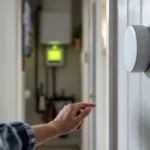
Finally, the thermostat sends output commands: turning the boiler or heat pump on and off, adjusting flow temperature, or nudging setpoints up and down.
Smart thermostat AI vs regular thermostats
A regular thermostat is essentially an on/off switch with a dial or basic buttons. You set a temperature and the boiler or heat pump fires until that level is reached, then stops. A programmable version adds fixed schedules (for example, 6-8 am and 5-10 pm), but it still follows whatever you manually entered, whether you are home or not.
A smart thermostat AI goes further by learning patterns and adjusting automatically. It uses occupancy data (from phone location or sensors), past behaviour, outdoor weather, and sometimes energy-tariff timings to decide when to heat and by how much. Instead of just switching on at 6 pm every day, it might pre-heat before you arrive, lower temperatures when you’re away, and optimise rooms differently if you have zoning.
For UK and German homes, the biggest visible changes are: easier app control, fewer cold starts and overheated rooms, and usually smoother boiler or heat pump operation. Comfort tends to increase because temperatures are kept steadier, while bills can fall because the system avoids heating empty rooms or running at unnecessarily high set points.
| Feature | Manual | Programmable | Smart AI |
|---|---|---|---|
| Control style | Dial/buttons | Fixed schedule | App + auto-learning |
| Learns habits | No | No | Yes, over time |
| Remote access | No | No | Phone and web |
| Zoning support | Rare | Limited | Common in EU kits |
| Impact on bills | Depends on user | Some savings | Often higher savings |
Energy savings you can realistically expect
Across independent reviews and field trials, smart thermostat AI typically cuts heating energy use by roughly 5-15% in ordinary European homes. That figure applies to both UK gas boilers and German systems (gas, district heating, some heat pumps), assuming the device is correctly installed and used.
Most savings come from tighter scheduling, automatic temperature setbacks when you are out or asleep, and better control of flow temperatures. In well-insulated homes with condensing boilers or modern heat pumps, the AI can run systems at lower, steadier temperatures, nudging efficiency up further. Poor insulation, leaky windows, or radiators left fully open in unused rooms reduce the impact, as the thermostat has less leverage.
As a simple example: a UK semi-detached home spending £1,200/year on gas might save £60-£180 per year; a German flat paying €1,000/year for heating could save around €50-€150. For heat pumps, percentage savings are often similar, but the impact on the electricity bill depends strongly on your tariff and whether the thermostat can align heating with cheaper off-peak periods.
Key factors that influence real-world savings in the UK and Germany include property insulation level, boiler or heat pump efficiency, how aggressively you let the AI lower setpoints when you are away, and whether you previously heated continuously.
| Home type | System | Annual bill | Typical saving |
|---|---|---|---|
| UK flat | Gas boiler | £800 | £40-£120 |
| UK semi | Gas boiler | £1,200 | £60-£180 |
| DE flat | Gas/district | €1,000 | €50-€150 |
| DE house | Heat pump | €1,600 | €80-€240 |
| Well-insulated | Efficient system | Varies | Upper 10-15% |
Key smart thermostat AI features explained
Most people asking what is a smart thermostat AI really want to know which features matter in daily use. Modern devices bundle several “intelligent” tricks that quietly adjust heating so you stay comfortable without wasting gas or electricity.
Learning schedules watch how you actually use heating over a couple of weeks, then build an automatic timetable, for example, warmer before you wake up, lower while you’re at work. This matters if your routine is fairly regular; if your days are unpredictable, you may rely more on manual control and quick app changes.
Geofencing uses your phone’s location to turn heating down when everyone leaves and start warming up as you head home. It’s powerful for commuters but less useful if someone is almost always in the house. Occupancy detection goes a step further, using motion sensors or smart radiator valves to notice when rooms are empty and trim heat there first.
Open-window detection spots a sudden temperature drop and temporarily turns the heating off, avoiding the classic mistake of “heating the street”.
How it fits UK and German heating systems
In most UK and German homes, a smart thermostat AI can slot into existing systems, but the fit depends on how your heating is wired and controlled. The easiest matches are modern gas combi boilers and air-to-water heat pumps that already use a room thermostat or programmer.
For UK and German combi or system boilers, smart thermostats usually replace the wall thermostat and/or programmer and talk to a receiver next to the boiler. Basic on/off control works almost everywhere. For the best efficiency, look for models that support OpenTherm or the boiler maker’s own “modulating” bus, so the thermostat AI can fine-tune boiler output instead of just blasting on and off.
Heat pumps in both countries often already include weather compensation and advanced controls. Here, the smart thermostat AI may either act as a simple room sensor and schedule, or integrate via the heat pump’s bus or gateway if supported. Check the heat pump brand’s compatibility list before buying; otherwise you may lose some built-in optimisation rather than gain it.
Installing and using a smart thermostat AI
Before anything else, confirm your heating type (combi boiler, system boiler with hot water tank, or heat pump) and whether your current controls are 230V mains or low-voltage. Check the smart thermostat’s compatibility list for UK or EU systems; if your home has older wiring, multi-zone valves, or underfloor heating manifolds, budget for a professional installer.
Wired smart thermostats usually replace the existing wall thermostat and/or programmer, with a receiver wired into the boiler or heat pump. This often needs an electrician or heating engineer, especially where there’s no neutral wire or where controls are inside the boiler case (opening it yourself can void warranties and be unsafe). Wireless kits add a battery-powered room unit and a hub or receiver near the boiler; these are simpler for DIY, but you still must isolate power at the consumer unit and follow the manual exactly.
In the UK and Germany, basic professional installation for a straightforward combi boiler is often priced similarly to a service call, while complex multi-zone or heat pump setups cost more because wiring and configuration take longer.
Is a smart thermostat AI right for you?
Smart thermostat AI delivers the most value to households with predictable weekday routines, commuters who leave empty homes for eight hours benefit from automatic setbacks that cut gas or electricity use by 15-25%. Owners of air-source or ground-source heat pumps see even larger savings because AI pre-heating algorithms avoid expensive resistance backup elements during cold snaps. Homes on time-of-use tariffs (Octopus Agile, E.ON Next Drive) gain further by shifting heat-pump operation to off-peak windows when wholesale prices drop below 10 p/kWh.
Conversely, households with irregular schedules, manual-only boilers lacking OpenTherm, or patchy Wi-Fi coverage will find limited advantage. Renters in flats with communal heating cannot install smart controls, and older gravity-fed systems may require expensive wiring upgrades before compatibility is assured.
| Your situation | Likely benefit | Key consideration |
|---|---|---|
| Commuter household, gas combi boiler | High (12-20% savings) | Ensure OpenTherm support for modulation |
| Heat pump with dynamic tariff | Very high (20-30% savings) | Check tariff API integration |
| Home all day, stable schedule | Moderate (5-10% savings) | Geofencing and voice control add convenience |
| Rented flat, no boiler access | Low to none | Seek landlord permission; portable options limited |
| Unreliable broadband | Low | Local learning degrades without cloud sync |
Authoritative resource: The Best Smart Thermostats We’ve Tested for 2026.
Frequently Asked Questions
What is the point of a smart thermostat?
The point of a smart thermostat AI is to keep your home comfortable while using less energy and giving you more control. It can adjust heating automatically, lower the temperature when you’re out, and be controlled via app or voice.
What does a smart thermostat use AI for?
A smart thermostat AI uses algorithms to learn when you’re usually home, what temperatures you prefer, and how quickly your home heats or cools.
How does a smart thermostat work?
First, the smart thermostat measures temperature and sometimes humidity and motion in each zone. Your settings and app inputs feed into its logic or AI model.
It then decides when to switch heating on, off, or modulate power, sending signals to the boiler or heat pump.
How do I use my smart thermostat?
Install the smart thermostat with the hub or receiver wired to your boiler or heat pump, then connect it to Wi-Fi and the app. Set basic comfort temperatures and approve or edit suggested schedules.
Use it normally for a few weeks so the smart thermostat AI can learn.
Does a smart thermostat use AI?
Not every smart thermostat uses AI. Some are simply app-controlled thermostats with remote access and basic schedules.
Smart thermostat AI models add learning features, occupancy detection, and predictive pre-heating. Look for terms like “self-learning”, “adaptive schedule”, “occupancy sensing”, or “predictive heating” in the product description to spot real AI features.
A smart thermostat AI automates heating decisions by learning your patterns and reacting to real-time conditions, but it’s not magic, it relies on consistent routines, compatible heating systems, and realistic expectations to deliver 10-20% energy savings in typical European homes. If your schedule is erratic, your boiler is very old, or you already manually optimise heating closely, the payback period may stretch beyond three years.
For most UK and German households with predictable weekday routines and compatible condensing boilers or heat pumps, a smart thermostat offers measurable convenience and modest bill reductions, provided you choose a model that integrates well with your existing setup and commit to a few weeks of learning time after installation.