



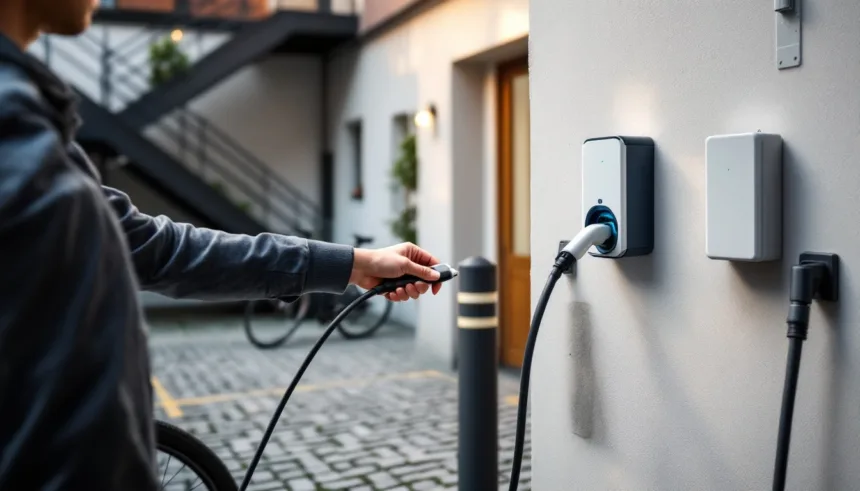
Owning an electric vehicle in Germany without a private garage is entirely feasible, but it requires a clear understanding of your charging options and the legal framework that governs them. Many German EV drivers live in apartments, park on the street, or share underground spaces, situations that demand practical solutions beyond the typical home wallbox setup.
- EV charger no garage in Germany: your options
- Legal basics for EV charger no garage Germany setups
- Smart use of public charging in Germany
- Costs compared: home, semi-private and public
- Planning your installation: step-by-step checklist
- Smart charging, solar and battery add-ons
- When public charging alone is enough
- Frequently Asked Questions
This guide walks through every realistic pathway for charging an EV with no garage in Germany: installing a wallbox in shared or semi-private parking, navigating landlord and tenant rights under the WEMoG reform, leveraging public and workplace infrastructure, and understanding the true costs and permissions involved. Whether you rent, own a flat, or park curbside, you’ll find a decision framework tailored to German regulations in 2025 and beyond, helping you choose the EV charger setup that fits your living situation and budget.
EV charger no garage in Germany: your options
If you own an EV in Germany and have no private garage or driveway, you still have several viable ways to charge at or near home. The best solution depends on where you park most nights, how your building is set up, and your driving pattern. The main paths are: shared underground parking with a wallbox, an outdoor wallbox on a house wall, workplace charging, semi-public chargers on private land, and relying on public AC/DC networks. Each has different costs, permissions, and reliability to consider when solving the “EV charger no garage Germany” problem.
| Option | Best for | Key plus | Key minus |
|---|---|---|---|
| Shared underground wallbox | Flats with Tiefgarage | Convenient home charging | HOA/landlord approval |
| Outdoor wallbox | Row houses, carports | Private, always free | Weather, installation cost |
| Workplace charging | Regular office workers | Charge while working | No weekend coverage |
| Semi-public private chargers | Retail, gyms, housing | Near-home flexibility | Tariffs, access limits |
| Public AC/DC network | Street parkers | Fast and widespread | Price, peak demand |
If your building has a Tiefgarage or shared car park, installing a wallbox on your own space (or using a building-wide system) is usually the closest experience to classic home charging. In Germany, tenants and condo owners now have strengthened rights to request such installations, but technical feasibility and cost allocation must be clarified with the Eigentümergemeinschaft or landlord, often with help from a specialist provider such as Mer Germany.
More Read
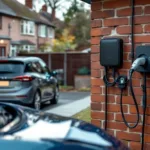
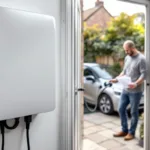
Without a garage, ground-floor or row houses can mount a weatherproof wallbox on the exterior wall or carport, provided cabling and pedestrian safety are addressed.
Related internal resource EV charging speeds explained home.
Legal basics for EV charger no garage Germany setups
If you want an EV charger with no garage in Germany, your options are shaped by a mix of civil law, building rules, and grid regulations. What you can install depends on whether you own, are part of a WEG (condominium association), or rent.
For owners in a Wohnungseigentümergemeinschaft, the Wohnungseigentumsmodernisierungsgesetz (WEMoG) gives a basic right to install a private charging point as a form of “privileged modernisation.” You still need a formal WEG resolution: the community can define how and where wallboxes are installed, cable routes, cost sharing for common-area upgrades, and technical standards, especially in underground garages or shared courtyards. They normally cannot block you outright but can require a professional plan and fair allocation of follow-up costs.

Tenants have a similar right in Mietrecht to request permission for a wallbox or fixed outdoor socket at their parking space. The landlord may refuse only for justified reasons (e.g., structural risk, lack of grid capacity) and can insist on using certified electricians, specific mounting locations, and removal of the installation when you move out. Costs for the EV charger itself are usually on the tenant; building-side upgrades are subject to negotiation or cost-sharing agreements.
Regardless of ownership, most fixed chargers for an EV charger no garage Germany installation must be notified to the local grid operator (Netzbetreiber), and larger units (often from 12 kVA/11 kW upwards) may require explicit approval or capacity checks. Many Stadtwerke and providers, such as Mer Germany , explicitly state that safe connection and grid registration via a licensed electrician are mandatory.
Related internal resource how does home EV charging work.
Smart use of public charging in Germany
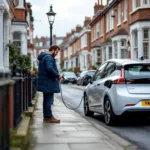
Without a private space, you can still run an EV in Germany by building a routine around public and workplace charging. Think in “charging sessions per week” rather than a fixed home EV charger: many drivers manage with one or two planned top-ups plus opportunistic plugs at work, supermarkets or gyms.
DC fast chargers (50-400 kW) on motorways and major roads are best for longer trips and quick weekend top-ups. AC posts (11-22 kW) near home or the office are cheaper and kinder to the battery, ideal if you can park a few hours. Typical public prices are around €0.39-€0.59/kWh on AC and €0.49-€0.79/kWh on DC, depending on tariff and operator.
| Location | Type | Typical price | Best use |
|---|---|---|---|
| Workplace | AC 11-22 kW | Often €0-€0.40 | Regular weekly charge |
| City street | AC 11-22 kW | €0.39-€0.59 | Overnight or evenings |
| Supermarket | AC or DC | Sometimes free or mid-range | Top-ups while shopping |
| Motorway | DC fast | €0.55-€0.79 | Trips and rapid boosts |
| Rural town | AC or slower DC | Often mid-range | Planned weekly session |
In cities, charger density is growing and reliability is generally good; within one app you can usually see live status and avoid broken or occupied points. Rural areas can still be patchy, so plan around a small set of dependable chargers you test yourself, and keep a buffer of range instead of running to near-empty.
To avoid peak prices, prefer off-peak or AC where time allows, and compare roaming providers (EnBW, Maingau, etc.) before committing.
Costs compared: home, semi-private and public
Costs for an EV charger with no garage in Germany depend heavily on where and how you charge. To keep things comparable, assume 15,000 km per year, an efficient EV using 18 kWh/100 km (2,700 kWh/year), and a petrol car using 7 l/100 km (1,050 l/year). Typical German prices mid-range: home electricity about €0.32/kWh, semi-private/tenant wallbox €0.36/kWh, AC public €0.45/kWh, DC fast charging €0.60/kWh, petrol €1.80/l. Real tariffs vary by city and provider, but the relative picture is stable.
| Profile | kWh price | 5-yr energy cost | Install / extras |
|---|---|---|---|
| 1) Public only | €0.45 | ≈€6,075 | €0 |
| 2) UG wallbox | €0.36 | ≈€4,860 | ≈€2,000 share |
| 3) Outdoor wallbox | €0.32 | ≈€4,320 | ≈€1,500 |
| 4) DC fast heavy | €0.60 | ≈€8,100 | €0 |
For a renter using only public AC, five years of charging costs around €6,075. A comparable petrol car would burn about 5,250 l, costing roughly €9,450 over five years, so even public-only EV charging can undercut fuel. This is often the starting point for people in dense cities looking for an EV charger with no garage in Germany.
An owner in an apartment with an underground garage wallbox pays slightly more per kWh than pure household power because of backend and billing, but gains comfort and still beats fuel. With a typical €2,000 one-off share of installation and hardware, total five-year cost lands around €6,860 (energy plus install). A terrace house with an outdoor wallbox on the private driveway usually gets near-household prices and simpler wiring. Even allowing €1,500 upfront, five-year total is about €5,820, the cheapest EV scenario here and significantly below combustion over the same distance.
The heavy user relying on DC fast charging pays a premium for speed and flexibility: about €8,100 for five years of energy, still a little below fuel for the same mileage but far more expensive than home or semi-private charging.
Planning your installation: step-by-step checklist
If you need an EV charger with no garage in Germany, planning is mainly about clarifying where you park and what the grid and property rules allow. Use this compact checklist to move from idea to installation without missing German-specific steps.
- Map your real parking situation
Where do you usually park at night: private driveway, Hof, carport, assigned space in a shared lot, or only on the street? Take photos, note distances to your flat’s meter room or house connection, and check if any cable would need to cross public pavement (usually not allowed). - Check your electrical capacity
Find your main breaker size and current flat fuse (e.g. 3x35A). Note existing big loads (electric heating, sauna, induction hob). This frames whether a 3.7 kW, 7.4 kW, or 11 kW wallbox is realistic. For a simple primer, see how does home charging work. - Clarify your legal status in the building
Are you tenant, owner in a WEG, or single-family homeowner? Tenants and WEG owners generally have a right to install, but must request permission, agree routing/common-area use, and often share documentation costs. - Talk to landlord/WEG early
Send a short written request with: parking spot ID, rough cable route, proposed wallbox power (usually 11 kW), who pays, and that the system will be installed by a certified electrician and registered with the grid operator. Ask if they want a standard solution for multiple future chargers. - Contact 2-3 local electricians
Ask specifically for wallbox installation in multi-family houses or outdoor spaces. Request: on-site visit, load calculation, costed options (e.g. 3.7 vs 11 kW), and whether they handle Netzbetreiber notification/approval. Compare quotes and timelines rather than just hourly rates. - Clarify grid notification and any approval
In Germany, 11 kW chargers are typically notifiable, higher powers often need explicit approval. Confirm with your installer who files which form and whether any capacity upgrade or load management is needed. You can cross-check general requirements in resources like Mer Germany’s home charging overview. - Choose wallbox power and smart features
Match charger speed to your daily kilometres and parking time; for basics on charge rates, see EV charging speeds explained home. Decide on: 11 kW vs slower, RFID or app access, load management, and whether you need billing-ready kWh metering for employer reimbursement or shared use. - Plan cable routing and protection
Agree with your electrician on underground vs surface-mounted cable to your non-garage space, mechanical protection (conduit, armored cable), signage, and how to avoid tripping hazards. Ensure nothing crosses public paths without explicit permission. - Set up billing and documentation
Keep invoices, electrical schematics, and grid notification for landlord/WEG and future resale. If your employer reimburses charging, configure user accounts, tariffs, and monthly reports in the wallbox app or backend. - Avoid the common mistakes
Typical problems in Germany include: using extension leads from a balcony, installing without landlord/WEG consent, skipping grid notification, oversizing the charger for your building connection, and forgetting
Smart charging, solar and battery add-ons
Even without a private garage, German EV drivers can leverage smart charging technology, dynamic electricity tariffs, and renewable energy systems to reduce charging costs and environmental impact. The key is understanding which combinations work for your specific living arrangement.
Smart charging with dynamic tariffs: If you have access to a wallbox in a shared underground garage or a semi-private parking space, pairing it with a dynamic electricity contract (such as Tibber or aWATTar) allows your vehicle to charge during off-peak hours when grid electricity is cheapest, often between 2 a.m. and 6 a.m. Many modern wallboxes include scheduling features or integrate with smartphone apps that automatically shift charging to low-cost windows. Even if you rely primarily on public charging, some networks now offer time-of-use pricing; charging overnight at slower AC stations can cost 30-40% less than daytime rapid sessions.
Rooftop solar with shared garage wallboxes: Apartment buildings and condominiums in Germany increasingly install photovoltaic arrays on rooftops. If your building’s wallbox infrastructure connects to a shared PV system, surplus solar energy can be directed to EV charging during daylight hours.
When public charging alone is enough
If you live with no private driveway or garage, running an EV in Germany on public charging only is often practical. The decision hinges on your weekly kilometres, routine access to chargers (work, supermarket, gym), and whether your building will realistically support a wallbox in the next few years.
| Profile | Weekly km | Public/work chargers | Home wallbox? |
|---|---|---|---|
| City commuter | <200 km | Easy and regular | Usually no |
| Mixed driver | 200-400 km | Several options | Nice-to-have |
| Heavy user | 400-700 km | Limited or busy | Strongly consider |
| Long-distance | >700 km | Motorway fast charge | Public often enough |
| Rural resident | Any | Few, far apart | Often essential |
You probably do not need a home EV charger if you drive under about 250 km per week, can plug in at work at least once or twice weekly, and have several reliable AC or DC stations within a short walk of home. In dense German cities, many EV owners successfully rely on supermarket, workplace, and neighbourhood kerbside points.
Start a wallbox project if your block has private parking that could be wired, you routinely exceed 400 km per week, or you find yourself planning life around public charger availability.
Frequently Asked Questions
How do you pay for electric car charging in Germany?
Most public chargers in Germany are paid via RFID card or charging app linked to a SEPA mandate or credit card. Common options include EnBW mobility+, Maingau, Elli, Shell Recharge and others.
Many stations now accept direct card (contactless) payment.
How can I charge my Tesla if I don’t have a garage?
In Germany, a Tesla without a garage is usually charged at Tesla Superchargers for fast trips and at Type 2 AC public chargers for regular top-ups. You can also install a Tesla Wall Connector or third-party wallbox in a shared or underground garage with owner approval.
How to charge EV car without charging station?
Without a dedicated charging station, you can sometimes use a standard Schuko socket and a mobile EVSE in Germany, but only on a properly fused, undamaged circuit and at reduced power. This should stay temporary due to heat and fire-safety concerns.
What is the best app for electric car charging in Germany?
Popular apps in Germany include EnBW mobility+ for wide network coverage and clear pricing, Maingau and Elli for competitive tariffs, and Shell Recharge or Plugsurfing as broad roaming options.
What are some tips and tricks for charging an electric vehicle?
Keep daily charging between about 20-80% or 90% for battery health, and use fast chargers mainly on long trips. In Germany, look for cheaper off-peak or supermarket tariffs and charge while shopping, commuting or at work.
Charging an EV charger with no garage in Germany comes down to matching your living arrangement with the right infrastructure and understanding your legal rights. If you have access to a shared parking space, the WEMoG law gives you a strong claim to install a wallbox with landlord cooperation.
For street parkers, a hybrid strategy combining workplace, destination, and selective fast charging keeps costs predictable and batteries healthy. Calculate your real monthly driving needs, map the public network in your area, and secure any necessary permissions early.
With the right plan, lack of a garage becomes a minor logistics question rather than a barrier to EV ownership in Germany.