



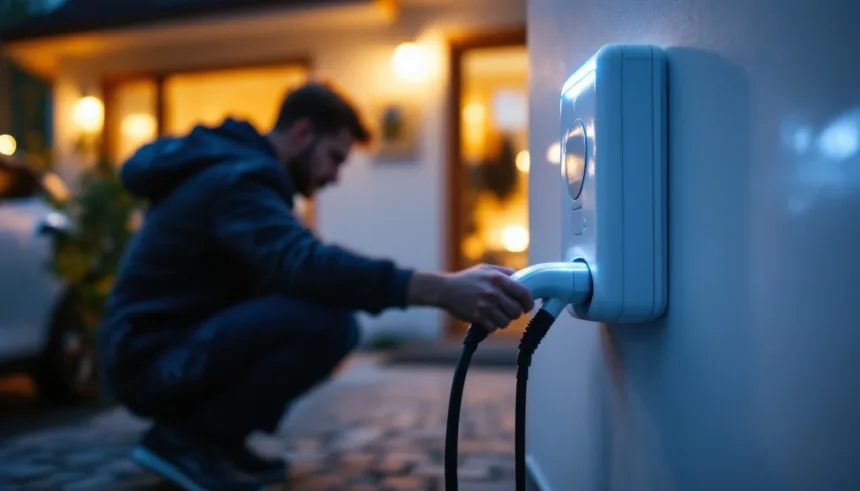
You’ve just plugged in your EV at 11 p.m., the charge port clicks shut, and a small voice wonders whether leaving it connected until morning will hurt the battery, or whether you’re even saving money if your tariff doesn’t have a proper off-peak window. Should you charge EV overnight?
- Should you charge EV overnight at home?
- How overnight charging affects EV battery health
- Overnight charging costs and off-peak tariffs
- When you should not charge EV overnight
- Best charging routine for everyday EV drivers
- Smart tools to schedule EV charging overnight
- Overnight EV charging with solar and home batteries
- Example overnight charging schedules to copy
- Common overnight EV charging mistakes to avoid
- Frequently Asked Questions
For most UK and German drivers on a time-of-use tariff, the answer is yes: overnight charging is the cheapest and most convenient way to refill your battery at home. The catch is how you do it.
Leaving the car at 100 per cent for hours on end can nudge down long-term battery health, and if you’re still on a flat-rate tariff you’re paying day-rate prices in the dark.
Should you charge EV overnight at home?
Picture this: it’s 10pm, you’ve just parked up outside, plugged the car in, and you’re wondering, “should I charge EV overnight or just leave it?” For most drivers in the UK and Germany, the honest answer is: yes, overnight home charging is usually the smartest and cheapest way to run an EV, as long as you set it up properly.

The big win is cost. Off-peak EV tariffs typically give you several cheap hours after midnight, so you might pay closer to 8-10p/kWh instead of 25-30p/kWh on a standard rate, or low-teens €-cents in Germany. That can turn a full “tank” from £20+ on a flat tariff to well under a tenner. Smart chargers and apps will do the faff for you: you plug in when you get home, they wait for the cheap window, then stop automatically.
Battery health is the bit people worry about. In practice, regular AC charging overnight is gentle on the pack. The trick is to avoid living at 100%. Set a charge limit of around 70-80% for day-to-day use and only push to 100% for early-morning road trips.
Related internal resource best smart EV charger UK.
How overnight charging affects EV battery health
You plug the car in after a long day, tap “charge overnight”, and then hesitate: should I charge EV overnight every night, or am I slowly cooking the battery? The honest answer: overnight AC charging is usually the kindest way to refill an EV, it’s how you do it that matters.

Modern lithium-ion packs hate two things: sitting at 100% for hours, and getting very hot. Slow home AC at 7 kW is gentle compared with DC rapid charging, which rams power in quickly and heats the cells. A 7 kW wallbox is roughly what the engineers design for daily use; regular DC fast charging, especially in summer or on motorways, is what tends to speed up degradation over several years.
| Charging style | Typical power | Heat / stress | Best use |
|---|---|---|---|
| Home AC overnight | 3-7 kW | Low | Daily top-ups |
| Public rapid DC | 50-150 kW+ | High | Trips only |
| Workplace AC | 7-11 kW | Low, medium | Daytime top-ups |
For battery health, try to live mostly in the 20-80% state-of-charge band. Use 100% for trips, not as your default. Most cars and smart chargers let you set a charge limit in the app, that’s your friend. Night EV tariffs like E.ON Next Drive or EDF GoElectric make it tempting to fill to the brim every cheap night, but you’re usually better off stopping at 70-80% on normal days.
Related internal resource off-peak EV charging AI schedule.
Overnight charging costs and off-peak tariffs
You plug in, brush your teeth, and by the time you’re making coffee in the morning the car’s full again. The real question is: did that quiet little habit just cost you 90p or nine quid? That’s where overnight charging and tariffs start to matter.
On a standard UK single-rate tariff you’re often paying around 28-30p/kWh. Off-peak EV tariffs can drop night rates closer to 8-12p/kWh, with suppliers like EDF offering specific overnight EV deals. In Germany it’s similar in spirit if not in numbers: a typical Haushaltsstrom might be ~35-40c/kWh, while a dedicated Nachtstrom or EV option can shave a decent chunk off that for set night hours.
| UK day rate | UK EV night | Germany approx. | |
|---|---|---|---|
| Unit price | ~30p/kWh | ~10p/kWh | ~35c/kWh |
| 30kWh top-up | £9.00 | £3.00 | €10.50 |
| Cost per 100km* | ~£4.50 | ~£1.50 | ~€5.25 |
*Assuming a fairly typical 15kWh/100km. On a UK off-peak EV tariff you’re basically getting three times the range for the same money compared with daytime. Some suppliers even bundle whole-house off-peak windows, so your dishwasher and immersion heater join the cheap party as well, as with EV-focused overnight tariffs.
If you’ve got or plan to get a smart charger, you can line all this up automatically: plug in any time, and let the charger or app choose the cheapest hours.
When you should not charge EV overnight
Picture this: you get home at 6pm, plug in out of habit, and your EV sits at 80% all night, every night. Feels sensible, but in quite a few cases, charging your EV overnight like that is just wasting money and nibbling away at battery life for no real benefit.
If you only drive, say, 40-60 miles a week, you don’t need a nightly top-up. A lot of modern EVs with 60-80 kWh batteries can easily give you 200+ miles in one hit. In that situation, aim to charge once a week or even once a fortnight instead of every night. A good rule of thumb: don’t bother plugging in until you’re under roughly 40-50% unless you know you’ve got a long trip coming.
Skip overnight charging as well if your car is already sitting at a high state of charge. Parking at 90-100% for hours, night after night, isn’t great for long-term battery health.
Best charging routine for everyday EV drivers
Picture this: you get home around six, battery at 38%, kids’ bath, dinner, TV… and at 10pm you suddenly remember you haven’t plugged in. This is exactly where a simple, repeatable charging routine saves you, you don’t want to spend every evening doing range maths in your head.
The sweet spot for most batteries is keeping day-to-day charge between about 30-80%, only going higher when you actually need the range. That’s your baseline, whether you’re using a wallbox like a Zappi/Ohme or just the granny cable in a pinch. Once you’ve set a charge limit in the car or app, the big decision isn’t so much “should I charge EV overnight?” as “how often do I need to reach my limit?“. For a lot of drivers, that’s every couple of days, not every night.
| Driver type | Daily use | Home routine | Fast/rapid use |
|---|---|---|---|
| Short commute | 10-25 miles | Charge to 70-80% twice a week | Almost never needed |
| Normal commuter | 25-50 miles | Plug in most nights, 80% cap | Top up only on big detours |
| Home-worker | Low in week | Single overnight to ~80% weekly | Use en-route on rare long trips |
| High-mileage | 60-120 miles | Nightly off-peak to 80-90% | Regular rapid top-ups on motorways |
| Road-tripper | Varies by week | Stay 40-80%; 100% pre-trip | Plan breaks at reliable hubs |
Smart tools to schedule EV charging overnight
You’ve plugged in after a late shop, wandered back into the kitchen and thought: “Did I actually tell the car to charge overnight, or is it about to guzzle peak-rate power right now?” Getting your overnight schedule right is the difference between paying 30p/kWh and something closer to 8-12p on a good EV tariff.
Start with the basics: your car and your wallbox will both try to be in charge, and they can fight each other. Pick a “boss” and stick with it. If you use the car’s app (Tesla, VW, BMW, Hyundai, etc.), set a simple window like 00:30-04:30 and a target state of charge (say 80%). Then put the charger into “dumb” or “charge when car asks” mode. Most smart chargers in the UK, Ohme, Pod Point, Wallbox Pulsar, Zappi, have that option in their app settings.
If you prefer the wallbox app, flip it: disable schedule or “departure time” in the car, and create one schedule in the charger app that matches your off-peak window.
Overnight EV charging with solar and home batteries
Picture this: it’s 11pm, your EV’s on the drive, the house is quiet, and you’re staring at three apps, solar, home battery, wallbox, wondering which should get the cheap electrons. This is where a bit of structure saves you money and protects your kit.
If you’ve got solar, the golden rule is simple: use daytime sun for the car whenever you can, and use overnight off-peak mainly to top up what solar couldn’t cover. On a bright April Saturday in the UK or Germany, you might easily push 15-25 kWh into the car from the roof alone. On dull winter weekdays, that drops, so overnight off-peak suddenly matters more.
With a home battery in the mix, the question isn’t just ” should I charge EV overnight ?” but “what charges first, house, battery or car?” On EV tariffs like EDF GoElectric with 4-5 cheap night hours or German night-time EV options from the big suppliers, you usually want to: 1) fill the home battery enough to cover the morning and breakfast peak; 2) then charge the EV with the remaining cheap window; and 3) leave a bit of headroom so the battery can still soak up sun next day instead of sitting at 100% all morning.
| Setup | Best focus | Charge timing | Key setting |
|---|---|---|---|
| Solar only | EV direct by day | Midday, sunny hours | Solar-match mode |
| Solar + EV | Day solar, night top-up | Solar first, then off-peak | Target SoC by 7am |
| Solar + battery | House first | Battery for morning use | Min house SoC reserve |
| Battery + EV tariff | Fill on off-peak | Whole cheap window | Time-based charge |
| All three | House → EV → grid | Solar by day, grid at night | Priority & export limits |
Example overnight charging schedules to copy
You plug in, head to bed, and hope you’ll wake up to a full battery and a sensible bill. Getting that right comes down to matching your overnight EV charging schedule to your tariff and how much you actually drive, rather than just whacking it to 100% every night.
Below are simple example routines you can copy and tweak in your car app or smart charger. Times and prices are real-world UK and German off-peak windows, but always double-check your own deal before you hit “save”.
| Scenario | Times | Target SoC | Est. cost |
|---|---|---|---|
| UK Octopus-style cheap window | 00:30-04:30 | 40% → 80% | ~£1.50-£2 / night |
| UK EV night tariff (e.g. EDF/Power NI) | 23:00-07:00 | 30% → 90% | ~7-9p/kWh off-peak |
| Germany dynamic tariff + solar | 02:00-05:00 | 50% → 75% | Focus on <€0.20/kWh slots |
| Home battery + EV (UK/DE) | Off-peak 01:00-04:00 | 50% → 80% | Charge both at off-peak |
For a UK “Octopus Go”-style plan, set the car or smart wallbox to start around 00:30 and stop at 04:30. Limit the charge to about 80% for day-to-day use and only bump to 100% before long trips.
Common overnight EV charging mistakes to avoid
You plug in at bedtime, wake up to 100 per cent, and assume you’re doing it right. Yet small missteps can quietly add pounds to your bill each month or shave years off your battery’s lifespan. Here are the pitfalls that catch most of us out, and the fixes that cost nothing.
- Charging to 100% every single night. Most manufacturers recommend a daily target of 80 per cent for lithium-ion longevity; reserve the full charge for long trips. Your car’s app or smart charger can enforce the limit automatically.
- Missing the cheap window. If you’re on a time-of-use tariff, say EDF GoElectric’s 00:30-07:30 slot at 8.5 p/kWh, but your car starts drawing at 23:00, you’re paying peak rates for half the session. Set a delayed-start timer in the vehicle or charger, not a plug-socket timer that bypasses the car’s battery-management system.
- Relying on a granny cable long term. The 3-pin emergency lead is fine for a weekend, but nightly 10 A draws stress ageing sockets and add hours to a refill. A dedicated 7 kW wall-box cuts charge time by two-thirds and unlocks smart scheduling.
- Ignoring battery preconditioning. Plugging in a frozen pack on a January morning means the first kWh go into warming cells, not range. If your EV supports it, schedule cabin and battery preheat while still connected to mains, you’ll leave with full range and a toasty cabin at no cost to the battery.
- Forgetting to update the tariff in your app. Switch supplier or move house, and stale off-peak times in your charger’s schedule can land you in the expensive daytime window. Double-check settings whenever your energy contract changes.
Frequently Asked Questions
How to schedule EV charger?
Start with your tariff.
Octopus Go 00:30-04:30, E.ON Next Drive 00:00-07:00, many German HT/NT meters 22:00-06:00). In the car menu (or Tesla / VW / BMW app), set “charge after” and “departure time” plus an 80% SOC limit.
Should I charge my EV to 100% every night?
No. Sitting at 100% every night, especially if the car stays warm, can slowly increase battery wear.
For daily use, aim to stop around 70-80% and only go to 100% before a long trip or occasionally for BMS calibration.
What is the 80/20 rule for EV charging?
The 80/20 rule just means keeping your battery roughly between 20% and 80% most of the time. Lithium-ion cells are least stressed away from the extremes, so this tends to preserve capacity.
What is the first step in should I charge EV overnight?
First, compare your unit rate day vs night. Look at your bill or app: if your off-peak price per kWh is clearly lower than daytime (for example 9-12p vs 25-30p in the UK, or 0.18-0.22 €/kWh vs 0.35-0.40 € in Germany), overnight charging is almost always worth planning.
How do homeowners know whether should I charge EV overnight is worth it?
Do two things for a month.
30p, 9p = 21p). Multiply by your typical monthly kWh into the car.
Second, track hassle: do your schedules work smoothly and still give you enough range each morning?
So should you charge EV overnight? If you’re on an off-peak tariff and set a sensible target, 80 per cent for daily driving, 100 per cent only before a long trip, then yes: overnight charging is both the cheapest and kindest approach for your battery.
Use your charger’s scheduler or the car’s own departure timer to land inside the cheapest window, and let the car finish an hour or two before you unplug so the pack isn’t sitting at peak voltage all night. That simple rhythm will save you hundreds of pounds or euros each year and keep your EV healthy for the long haul.