



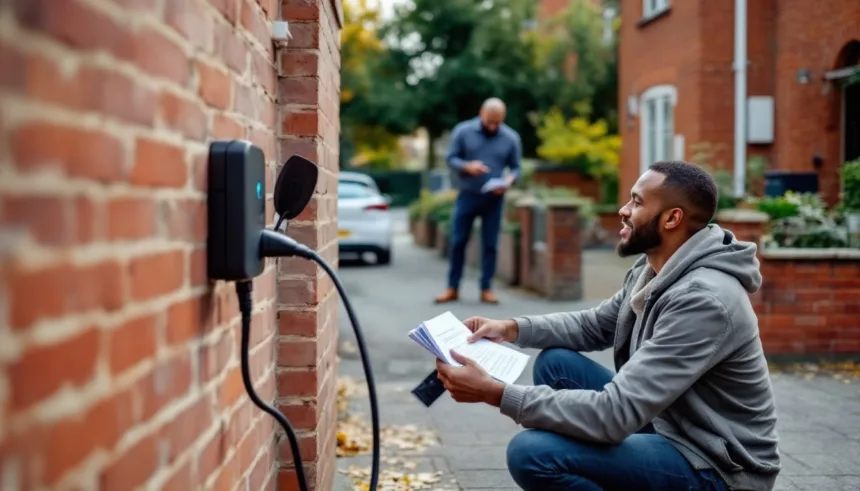
If you’re wondering whether the EV charger grant UK eligible 2026 rules still apply to you, the short answer is yes, but only if your property and circumstances meet the Office for Zero Emission Vehicles (OZEV) criteria. As of April 2026, the grant structure has shifted: homeowners in single-occupancy houses are no longer eligible, but residents of flats, rental properties, and workplace sites can still claim £350 to £500 toward an approved smart charger installation.
- EV charger grant UK eligibility in 2026
- EV Charger Grant UK Eligible 2026
- Eligibility for homeowners in houses
- Renters and flat owners: who qualifies
- Landlord and block grants explained
- Workplace Charging Scheme in 2026
- How to apply for an EV charger grant
- Charger, wiring and safety requirements
- Frequently Asked Questions
This guide cuts through the policy updates to show you exactly which scheme applies to your situation, what documentation you’ll need, and how to pair your new charger with other UK incentives like home battery storage grants for maximum savings.
EV charger grant UK eligibility in 2026
The EV charger grant UK eligible 2026 rules have changed but the schemes are still alive. In 2026 you can usually get £350-£500 off the cost and installation of a qualifying smart home or workplace chargepoint through OZEV (the Office for Zero Emission Vehicles). Which EV charger grant you use depends on whether you’re a homeowner in a house, a flat-dweller, a renter, a landlord or a business.
Headline position for 2026:
- Yes, UK EV charger grants still exist, but only via OZEV chargepoint schemes, not as a car discount.
- Home-focused grants (mainly flats and renters) are typically worth up to £350 per socket.
- From April 2026, some schemes move to a new headline £500 maximum where extra installation work is needed (for example, longer cabling or limited on-site capacity).
- Workplace and landlord schemes usually cover up to 75% of hardware and installation cost, capped per socket and per site.
A quick 30-second check on whether you might be EV charger grant UK eligible 2026:
- You live in the UK (not the Channel Islands or Isle of Man), and the property has private, off-street parking you control.
- You own or use an eligible electric vehicle or committed to one via order or lease by the time of installation.
- You choose an OZEV-approved smart charger model and use an OZEV-authorised installer.
- You haven’t already had a home EV chargepoint grant at this property under an earlier scheme, unless a specific multi-socket or landlord variant allows it.
- For flats/renters: your home is a flat or rented property, and the owner/landlord agrees where required.
- For workplaces: your business, charity or public sector body is based in the UK, has dedicated parking and isn’t applying for excluded vehicle types.
Related internal resource how to apply UK battery grant.
EV Charger Grant UK Eligible 2026
If you are asking whether there is an EV charger grant UK eligible 2026 for your situation, the answer depends on where you live and whether you own, rent, or manage property. In 2026, most support is channelled through Office for Zero Emission Vehicles (OZEV) schemes that cut the upfront cost of installing chargepoints rather than discounting the car itself. OZEV funds and shapes the rules, while approved installers claim the grant on your behalf after fitting a compliant smart charger.
These EV charger grants are separate from any electric car purchase incentives and focus only on the charging hardware and installation. At the new £500 cap from April 2026, they are designed to make home, multi-occupancy and workplace charging more accessible, especially where on-street or communal parking would otherwise be a barrier.
| Grant scheme | Who it targets | Typical cap | Key requirement |
|---|---|---|---|
| EV chargepoint grant | Renters & flat owners | Up to £500 | Private off-street space |
| Landlord grants | Residential & commercial | Per socket limit | Letting or intending to let |
| Workplace Charging Scheme | Employers & fleets | Per socket, capped sites | Business or charity status |
| Residential car park grants | Blocks of flats | Per bay & project cap | Long-term resident use |
| Targeted home schemes | Specific low-income areas | Varies by fund | Location or income criteria |
For individuals, the main EV chargepoint grant helps renters and flat owners with off-street parking reduce installation cost, while separate building and infrastructure support exists for blocks of flats where cabling to multiple bays is the real expense. For property owners, dedicated landlord grants support installing chargepoints at residential and commercial sites intended for tenant or staff use. For businesses and charities, the Workplace Charging Scheme offers a per-socket contribution to onsite charging, often used for fleets or employee cars. OZEV’s official page on electric vehicle chargepoint grants is the place to confirm eligible vehicles, installer requirements and the most current claim limits if you want to be sure you remain EV charger grant UK eligible 2026 and beyond.
Related internal resource Germany KfW battery subsidy 2026.
Eligibility for homeowners in houses
If you own and live in a single UK house (not a flat or maisonette), you are generally not eligible for the main OZEV home EV charger grant in 2026. The government’s electric vehicle chargepoint grants now focus on people in flats, renters, and landlords, plus separate support for workplaces, rather than typical owner-occupiers of individual houses.
In 2026 the key OZEV schemes still running are targeted narrowly. The home chargepoint grant applies to people who live in flats or rental accommodation, and to landlords installing chargers on their properties. There are also grants for developers of new-build homes and for workplaces under the Workplace Charging Scheme. None of these standard routes cover an owner-occupier installing an EV charger on their own freehold house, unless the property is formally classed as a flat (for example, a self-contained maisonette) or you own the home as a landlord rather than living in it.
There are a few edge cases. If your home is part of a converted building with multiple dwellings and you legally own a flat within it, you may be able to use the flat/renter grant despite living there as an owner-occupier. Similarly, if you are buying a new-build and the developer chooses to use available EV infrastructure funding, the effective subsidy is baked into the installation they arrange rather than claimed by you directly. However, these situations depend on the property’s legal status and the developer’s choices, not on being a typical homeowner in a standalone house.
Because the usual OZEV route is closed for most houses, the focus shifts to reducing EV charging costs in other ways. The most immediate options are smart EV tariffs (cheaper night-time rates for home charging), pairing a smart charger with a home battery using current incentives, and timing charging around off-peak or agile tariffs. Smart time-of-use tariffs can cut per-kWh costs significantly if you regularly charge overnight.
Renters and flat owners: who qualifies
The main EV charger grant UK eligible 2026 route for renters and flat owners is the OZEV “EV chargepoint grant”. It pays part of the cost of buying and installing a home chargepoint for people without outright ownership of a normal single dwelling house.
In 2026, you must meet three layers of rules: you (the applicant), your vehicle, and the property/parking space. An OZEV-authorised installer then applies on your behalf through the official chargepoint grants guidance.
| Scenario | Likely eligible? | Grant level 2026 | Key condition |
|---|---|---|---|
| Renter in house | Yes, if driveway | Up to £350 | Off-street parking at home |
| Flat owner-occupier | Yes, most cases | Up to £500 | Allocated or agreed space |
| Flat tenant | Often, with consent | Up to £500 | Landlord/agent written OK |
| Street parking only | No | £0 | No private bay/drive |
| Holiday / Airbnb | Usually no | £0 | Must be main home |
You must live in England, Scotland or Wales and either rent your home or own a flat (leasehold or share of freehold). You need a qualifying electric vehicle: usually a fully electric or plug-in hybrid that appears on the OZEV approved vehicle list, either owned, leased, or on a salary-sacrifice/company scheme assigned to you. The car must normally be kept at the property where the charger is installed.
The charger must be installed at your main residence, not a second home. You need off-street parking that you control or have documented rights to use, such as:
- a shared parking area where the freeholder or managing agent has formally agreed to your charger and cable route.
Purely on-street parking, even with a residents’ permit, does not qualify under the EV chargepoint grant rules.
Historically the EV charger grant for renters and flat owners paid up to £350, covering 75% of the installation cost. From April 2026, the cap for qualifying flats and rental properties rises to up to £500, still limited to 75% of total cost. This higher £500 level is mainly aimed at situations with extra wiring or civil works, such as running cabling from a basement meter room to an outdoor car park.
Indicatively in 2026, a straightforward wallbox installation for a tenant in a house with a driveway may still fall within the £350 cap, so the practical difference is small.
Landlord and block grants explained
For 2026, OZEV keeps two main EV charger grant routes open for UK landlords: the “EV chargepoint grant for landlords” and the “EV infrastructure grant for residential car parks”. Both are claimed by the landlord or freeholder, not by individual tenants, and both must be installed by an OZEV-authorised installer.
You count as a landlord for these EV charger grants if you are an individual, company, housing association, local authority, right-to-manage company or similar entity that rents, leases or owns residential property (including HMOs and blocks of flats), even if the parking area is shared. Managing agents can apply on behalf of the legal owner if authorised.
| Grant type | Use case | Per-unit cap | Max units |
|---|---|---|---|
| Chargepoint grant | Finished bays with sockets | £350 per socket | Up to 200 sockets |
| Infrastructure grant | Cabling & future bays | £500 per parking space | Up to 30 spaces |
| Tenants’ grants | Individual flat/renter grants | £350 per socket | One per eligible tenant |
The landlord chargepoint grant helps pay for live, ready-to-use sockets in private or shared car parks attached to the property. It is designed for smaller numbers of bays (for example, four spaces serving an HMO) and can be combined across multiple properties up to the overall cap. Each funded socket must have safe, off-street parking and normally be reserved for residents or staff, not general public use.
The residential car park infrastructure grant focuses on the expensive groundwork: ducting, cabling, distribution boards and load management that can later serve many bays. You can claim for a mix of “active” bays (with chargers fitted now) and “passive” bays (cabled and ready for later). This suits blocks of flats or larger HMOs where EV uptake is expected to grow and helps future-proof the site without reopening car parks repeatedly.
Stacking is allowed as long as you do not claim twice for the same cost. A landlord might use the infrastructure grant to fund cabling for 20 bays in a block’s underground car park, then separately use the landlord chargepoint grant to discount eight chargers fitted immediately.
Workplace Charging Scheme in 2026
From April 2026, the Workplace Charging Scheme (WCS) continues as the UK’s main EV charger grant for employers, offering up to £500 per socket towards installation, covering up to 75% of purchase and installation costs. It is aimed at organisations rather than private individuals, but employees benefit through cheaper or free charging at work, especially if they cannot install a home charger.
The WCS is administered by OZEV and operates as a voucher scheme for businesses, charities and public-sector bodies. You apply online, receive a voucher if eligible, then give that voucher to an OZEV-authorised installer who redeems it after the chargepoints are commissioned.
| Item | Limit | Notes |
|---|---|---|
| Grant rate | 75% of costs | Hardware & install |
| Cap per socket | £500 | Max grant per outlet |
| Max sockets/site | Up to 40 | Per location cap |
| Max sockets/org | Up to 40 | Across all sites |
| Ownership | Organisation | Not employees |
To qualify, an organisation must be UK-registered (or have a UK branch), have off-street parking where the chargers will be installed, and declare a current or future need for EV charging (for staff, fleets or visitors). SMEs, registered charities and most public-sector bodies are typically eligible, provided they meet standard criteria such as having no more than the allowed number of sockets and following state-aid/subsidy rules. Large corporations can also apply, but the scheme is particularly useful for smaller employers that need help with upfront costs.
Employees who cannot charge at home, because they rent, live in flats without allocated parking, or have on-street parking, gain access to regular, often lower-cost charging at work. Employers can set different tariffs for staff, fleet and visitors, or offer free charging as a perk, subject to tax rules. Many businesses combine the Workplace Charging Scheme with internal policies such as EV-only parking bays, salary sacrifice EV schemes, and smart charging controls to spread demand. Current parameters and application details are outlined on the official Workplace Charging Scheme guidance, which should be checked for any updates before you apply.
How to apply for an EV charger grant
Most OZEV EV charger grants in the UK follow the same basic flow: you choose an OZEV-approved installer, they confirm your eligibility, apply for the grant on your behalf, then discount the grant from your invoice. You never receive the money directly. The key to a smooth 2026 application is preparing documents early and matching the right scheme to your situation.
Start by picking the scheme that actually fits you in 2026:
- Home: flat owners and renters (EV chargepoint grant for flats/renters).
- Landlords: registered landlords, right-to-manage, housing associations, companies owning residential property.
- Workplace: businesses, charities, public-sector bodies via the Workplace Charging Scheme (WCS).
Once you know your route, find an OZEV-approved installer in your area (search their own or government list). Ask them directly whether they are currently claiming at the April 2026 £500 level for your scheme and vehicle type. Shortlist 2-3 installers and request written quotes that clearly separate equipment, installation, and any extra works (e.g. load management, groundworks, consumer unit upgrades).
In parallel, gather the documents you will usually need:
- Proof you own or use an eligible EV or plug-in hybrid (V5C, lease or salary-sacrifice agreement).
- Proof of address (recent utility bill, council tax, bank statement).
- Tenancy agreement or lease if you are a renter, or proof of flat ownership (Land Registry, service charge statement).
- Landlord consent if you do not own the property.
- For landlords: proof you are the landlord entity and details of each property (addresses, UPIs if requested).
- For workplaces: Companies House details or charity registration, site address, and a simple plan of where bays will be.
Before you sign anything, your installer should confirm technical eligibility and grant availability:
- Property type matches the scheme (e.g. flat vs house).
- Off-street parking or allocated space is available, or a compliant solution is planned.
- Chargepoint model is OZEV-approved and smart (can be remotely managed and scheduled).
- No previous incompatible grant has been used at the same property/space under current rules.
Most home and landlord schemes are installer-led. The typical step-by-step flow looks like this:
- You send scans/photos of documents plus photos of your parking space, meter, consumer unit, and cable route.
- Installer pre-checks eligibility, then issues a quote showing the grant amount that will be claimed.
- You sign a work agreement that states your chosen grant scheme and confirms you will provide honest information.
- Installer creates your application on the OZEV portal, using your documents and property details.
- OZEV issues provisional approval (often quick, but allow up to a few weeks in busy periods).
- The installation is carried out, with any additional electrical works and, if relevant, integration with home batteries or energy management.
- Installer submits completion evidence (photos of charger, serial number, installation certificate, commissioning data).
- OZEV pays the grant to the installer, who has already deducted this from your final bill.
- Mapping which parking bays are for which flats or tenants.
- Clarifying ownership of car parks (freehold vs managing agent).
- Agreeing how ongoing electricity and usage will be billed to residents.
- Confirm you are an eligible organisation and site (UK-registered, off-street parking, chargers for staff/fleet rather than general public).
- Gather company details (registration number, address, contact) and expected number of chargers and sites.
- Apply online for a WCS voucher code through the government portal (see the dedicated Workplace Charging Scheme page).
- Choose an OZEV-approved installer and send them your WCS voucher.
- Installer completes the works within the voucher validity period and redeems the voucher after installation.
Charger, wiring and safety requirements
To qualify for any OZEV-funded EV charger grant in the UK in 2026, the hardware, wiring and installation must meet specific technical, safety and “smart” standards. The grant is only paid if the charger and installer are both approved and the installation is documented correctly.
First, the chargepoint itself must be on the current Office for Zero Emission Vehicles (OZEV) approved list. That list is updated periodically and includes only units that meet UK smart charging regulations, BS EN standards and cybersecurity requirements. Smart capability is mandatory: the charger must be able to schedule charging, respond to external signals (for example from an energy supplier or aggregator), and record usage data. It also needs default off-peak charging settings and the ability to limit or pause charging remotely to reduce pressure on the grid.
Domestic and workplace installations must comply with BS 7671 (IET Wiring Regulations) and relevant IET Code of Practice for EV charging equipment. That covers cable sizing, RCD protection, fault-current ratings, and correct use of dedicated circuits. In most homes, the charger should be on its own suitably rated circuit from the consumer unit, not spurred off existing socket circuits. Load-management is now a core requirement for grant-eligible installations: either the charger or an associated device must monitor the property’s total demand and automatically reduce charging current, or shut off charging, if the main supply is close to its limit, reducing the risk of nuisance trips or overheating.
Many modern chargers use built-in PEN-fault protection so they can be installed without adding earth rods, but the earthing arrangement must still be designed and tested by a qualified electrician. Correct earthing and bonding is essential for safety, compliance with building regulations Part P, and to avoid future disputes with building control or insurers if something goes wrong.
Frequently Asked Questions
Who qualifies for an EV charger grant?
In 2026, EV charger grant UK eligible 2026 rules depend on the scheme. Flat owners and renters with a dedicated parking space can use the OZEV EV chargepoint grant.
Residential and commercial landlords can claim for their properties. UK businesses, charities and public sector bodies can use the Workplace Charging Scheme.
Who is eligible for an EV charger grant?
Eligibility for an EV charger grant in the UK in 2026 depends on who you are and where the charger goes. A renter in a flat with allocated off-street parking and an eligible EV or order can use the home chargepoint grant.
Is the 500 home EV charger grant still available?
From April 2026, the main OZEV home EV chargepoint grants for renters and flat owners in the UK increase up to £500 per socket, within the usual percentage cost cap. The old £350 approvals still stand on their original terms and cannot simply be uplifted.
How long does it take for an OZEV grant to be approved?
For most EV charger grant UK eligible 2026 applications, OZEV approval after installer submission typically takes around 2-4 weeks, with grant payment going directly to the installer. Delays arise from incomplete photos, missing proof of keepership or tenancy, or unclear parking evidence.
Can a normal electrician install an EV charger?
To use any OZEV EV charger grant in the UK, the charger must be supplied and fitted by an OZEV-authorised installer with suitable competence, registration and certification. A “normal” electrician who is not on the OZEV approved list cannot claim the grant.
Navigating the EV charger grant UK eligible 2026 landscape is straightforward once you know which OZEV scheme matches your property type and occupancy. Focus on confirming your eligibility early, check the flat/rental/workplace criteria, gather proof of ownership or landlord consent, and choose an OZEV-authorised installer who will handle the grant claim on your behalf.
If you’re also considering home battery storage, explore how a smart charger can integrate with time-of-use tariffs and battery systems to cut energy costs further. With the right preparation and a clear understanding of the April 2026 caps, you can secure your grant, install a compliant chargepoint, and future-proof your home or business for electric mobility.