



Living in a small UK flat or terraced home doesn’t automatically rule out a home battery in 2026.
- Best home battery options for a small UK flat
- Can a best home battery small UK flat actually be installed?
- How to size a battery for a flat or small home
- Compact battery types suited to small UK flats
- Top flat-friendly battery brands and systems in 2026
- Costs, savings and payback in a small UK flat
- Practical installation, noise and safety in tight spaces
- Decision checklist for small UK homes and flats
- Frequently Asked Questions
Best home battery options for a small UK flat
If you live in a small UK flat and want the best home battery small UK flat setup for 2026, focus on compact, quiet systems that can run from a single circuit and don’t need roof solar. Three categories cover almost everyone.
1. Best plug-in / low-disruption battery, portable “power station” style (1-2 kWh)
Examples include compact LFP power stations that charge from a 13A socket and sit under a desk. Typical usable capacity: 1-2 kWh. Installed cost: £700-£1,600. Suits renters or leasehold flats where fixed wiring changes are hard. Best for: running a home office, internet, lighting, or fridge through short cuts or evening peak prices without landlord permissions. Limit: not usually wired into the flat’s consumer unit, so only powers what you plug into it.
2. Best wall-mounted LFP system for small flats, fixed 3-5 kWh unit
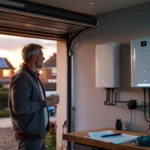
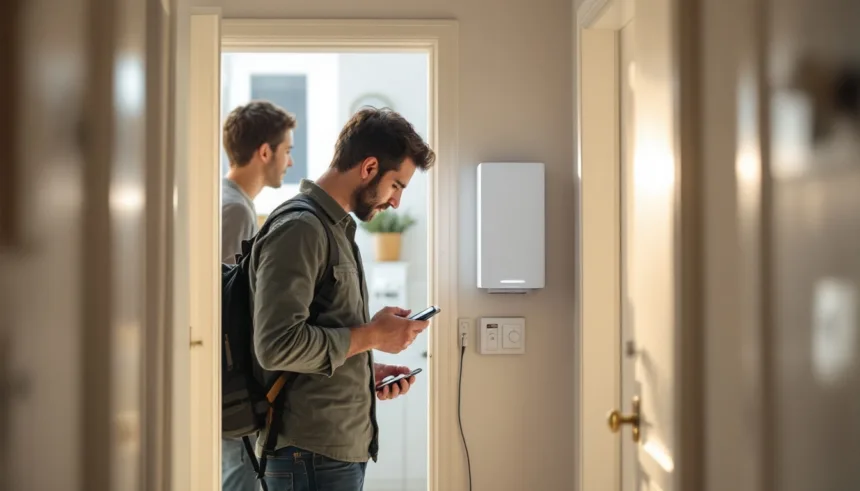
Slim lithium iron phosphate batteries from mainstream brands (often 3-5 kWh) can wall-mount in a cupboard, utility nook, or hallway. Fully installed with a small hybrid/AC-coupled inverter they typically land around £3,000-£4,500. Suits owners of small 1-2 bed flats or compact terraces on single-phase supply who want automatic whole-flat support for evening usage or time-of-use tariffs, with minimal floor footprint and good fire safety characteristics.
More Read
- In a very small UK flat, prioritise wall-mounted or portable LFP units over bulky floor cabinets.
- For renters, choose plug-in or non-permanent systems that avoid wiring changes.
- For owners with time-of-use tariffs, a fixed 3-6 kWh system is often the best balance of cost, savings, and space.
- Always confirm installer competence, fire-clearance requirements, and any DNO / building control constraints before committing.
Related internal resource how home battery saves money.
Can a best home battery small UK flat actually be installed?
In most cases a home battery can be installed in a small UK flat, but it is more permission-heavy than in a house. For a best home battery small UK flat setup you must first clarify tenure: if you are leasehold, you usually need written consent from the freeholder or managing agent, because the battery is a fixed electrical installation and often affects common areas (meters, risers, external walls). Tenancy agreements for renters nearly always require landlord consent as well.
Fire safety and building regs are the main technical hurdles. Modern lithium systems are normally placed in a ventilated area away from escape routes; most competent installers will refuse to mount batteries in internal hallways or on shared stairwells. Better locations for small flats include: inside a utility cupboard with adequate clearances, on a private balcony, in a private ground-floor store, or in your allocated garage. Some blocks explicitly ban batteries on balconies, so your building’s fire risk assessment and house rules matter as much as UK guidance.
Your installer must also notify, and sometimes get pre-approval from, the Distribution Network Operator (DNO). Even a stand-alone battery without solar can need approval above certain kW limits, and older blocks with limited supply capacity may only allow smaller systems.
Related internal resource home battery sizing guide kWh.
How to size a battery for a flat or small home
For a best home battery small UK flat setup, start from your smart meter data. Take your average daily usage in kWh, then decide how much of that you realistically want to shift to cheap/night or solar power. In most 1-2 bed flats, that is only part of your total use, not all of it.
A simple rule of thumb: size the battery to cover your typical evening and early-morning demand (for time-of-use tariffs) or your usual after-dark consumption (for solar). If your daily use is 6-8 kWh in a flat, a 3-5 kWh battery usually covers the high-value part of that load.
| Home type | Daily use | Typical size | Notes |
|---|---|---|---|
| 1-bed flat | 4-6 kWh | 2-4 kWh | Night tariff only |
| 2-bed flat | 6-8 kWh | 3-5 kWh | Good for evenings |
| Small terrace | 8-12 kWh | 5-7 kWh | With some solar |
| Small terrace + EV | 12-18 kWh | 7-10 kWh | Shift off-peak use |
| High-use small home | 15-20 kWh | 8-10 kWh | All-electric heating |
Use the smaller end of the range if you are on Economy 7 or an “Intelligent” EV tariff and mainly want to run appliances, lighting and electronics on cheap electricity.
Compact battery types suited to small UK flats
For a best home battery small UK flat setup, you’re mainly choosing between slim wall units, stackable floor towers, or plug-in “apartment batteries”. In tight spaces, Lithium Iron Phosphate (LFP) chemistry is strongly preferred: it’s more stable, handles frequent cycling, and usually allows installation closer to living areas with minimal ventilation measures.
| Type | Space use | Noise/venting | Best for |
|---|---|---|---|
| Wall all-in-one | Shallow, off floor | Very low noise | Hallway, utility |
| Stackable floor | Small footprint | Low fan noise | Cupboard, corner |
| Plug-in/portable | Moves as needed | Audible at charge | Rentals, balcony |
| AC-coupled | Extra small box | Near-silent | Adding to any flat |
| Hybrid inverter | Bigger, more kit | Low, outside ideal | With new solar |
All-in-one wall batteries pair a slim LFP pack with an integrated inverter, so cabling is short and tidy and there’s usually just one external isolator. They suit owner-occupied flats where a fire-rated cupboard, hallway, or small utility space is available, and they keep DC cabling minimal. Stackable floor systems use separate LFP blocks on a small base; they’re ideal where wall mounting is hard (e.g. plasterboard partitions) but you have a spare corner.
Plug-in balcony or portable units are realistic for renters and German-style balcony solar: you plug them into a dedicated socket and avoid intrusive cabling or DNO approvals, but capacities are modest and they won’t normally back up whole circuits.
Top flat-friendly battery brands and systems in 2026
For a small flat, the best home battery options balance compact size, safe chemistry, and flexible installation. Most flat-friendly systems use LiFePO₄ (LFP) cells, wall or floor mounting, and modular stacks that can start around 5 kWh and grow if you move to a larger UK home later.
| Brand / system | Module size | Chemistry | Guide installed cost* | Best for |
|---|---|---|---|---|
| GivEnergy | 5.2-9.5 kWh | LFP | £4,000-£8,000 | Owners with loft / cupboard |
| Sunsynk | 5-8 kWh | LFP | £4,000-£7,500 | Small houses, high use |
| Fox ESS | 2.9-5.8 kWh | LFP | £3,500-£7,000 | Narrow spaces, stackable |
| Enphase IQ | 3-5 kWh | LFP | £3,000-£6,000 | Flats with solar, outside wall |
| EcoFlow / Anker | 1-5 kWh | LFP (most) | £800-£3,000 | Renters, plug-in only |
*Very rough UK 2026 installed ranges for small systems; final price depends on inverter choice, installer rates and DNO / wiring complexity.
GivEnergy and Sunsynk are common choices for small UK homes with a spare cupboard, under-stairs area, or loft. Both use LFP, offer 10-12 year warranties, and pair well with off-peak tariffs plus solar. They suit owners who can mount a dedicated inverter and may add more capacity later.
Fox ESS offers slim, stackable modules that work where floor depth is tight, for example next to a washing machine in a utility corner. Warranties are typically up to 10 years, and systems are often chosen when installers need flexibility around pipework and gas meters.
Tesla Powerwall 3 (where space allows) integrates inverter and battery into one tall outdoor unit, typically 13-14 kWh. It can be overkill for a studio flat, but for a small terraced home with driveway or garden wall it delivers strong app control and backup at £8,000-£11,000 installed.
Costs, savings and payback in a small UK flat
For a best home battery small UK flat setup, you’re usually looking at 3-6 kWh usable capacity, wall-mounted, and often standalone (no solar) using a smart off-peak EV or agile tariff.
| Home type | Size (kWh) | Installed cost | Typical bill cut |
|---|---|---|---|
| 1-bed flat | 3-5 | £2,500-£3,800 | 15-30% |
| 2-bed flat | 5-8 | £3,500-£5,500 | 20-35% |
| Small house | 7-10 | £4,500-£7,000 | 25-45% |
Most of that cost is hardware (battery, inverter, monitoring), plus labour, DNO approval work, and any fire-safety upgrades or landlord/freeholder sign-offs. Solar-connected systems trend towards the higher end, especially if retrofitting onto older PV.
In a small UK flat without solar, savings mainly come from time-shifting: charging the battery on cheap night rates and discharging during peak prices. With solar, you add the benefit of storing your own export instead of selling it cheaply. For the underlying mechanics, see this deep dive on how home battery saves money.
Worked example: 1-bed London flat, Octopus Intelligent
Assume: 2,800 kWh/year use, Intelligent off-peak ~7.5p/kWh for 6 hours, peak ~29p/kWh; 5 kWh battery, 90% round-trip efficiency, cycling once per day.
- Energy shifted daily: ~4.5 kWh usable
- Saving per kWh: ~21.5p (29p, 7.5p)
- Daily saving: 4.5 kWh × £0.215 ≈ £0.97
- Annual saving: ≈ £350
- Installed cost: say £3,200
- Simple payback: £3,200 ÷ £350 ≈ 9 years
Practical installation, noise and safety in tight spaces
In a small UK flat, the main constraints for a home battery are where it can physically sit, how it’s fixed, and how safely it can be wired back to the consumer unit. Wall-mounted systems concentrate weight on fixings; block walls usually cope, but dot-and-dab plasterboard party walls often don’t. Floor-standing units spread weight better but still need a level, dry area that’s not blocking escape routes.
Fire safety is critical in tight spaces. Most manufacturers require non-combustible surroundings, clearances around vents, and no storage directly on or over the unit. In many flats, that means a small utility area, hallway recess, or a fire-rated cupboard with louvred or ducted ventilation. Landlords and managing agents may insist on formal fire-risk sign-off before anything is fixed in common or escape areas.
Inverters and fans are the main noise source; even “quiet” units can hum or whirr under load. Avoid bedrooms and thin party walls where possible, and ask the installer for dB ratings plus a plan for anti-vibration mounts.
Decision checklist for small UK homes and flats
Before committing to a battery, work through this checklist to confirm fit and value for your small UK flat or home:
- Check eligibility: Confirm you own the property or have landlord consent; verify your consumer unit has space for a battery isolator and meets 18th Edition wiring standards.
- Assess tariff benefit: Compare your current tariff’s peak and off-peak rates; a minimum 15 p/kWh spread (e.g. Octopus Intelligent Go at 7 p vs. 24.5 p peak) justifies arbitrage.
- Calculate daily usage: Review your smart meter data for typical daily consumption; most small flats use 6-12 kWh/day, suggesting a 5 kWh usable battery is sufficient.
- Measure available space: Identify a wall or cupboard with at least 60 cm width × 80 cm height × 20 cm depth; confirm ambient temperature stays below 25 °C year-round.
- Set a realistic budget: Expect £3,500-£5,500 installed for a 5 kWh AC-coupled system; add £500-£800 for DNO G99 application if required.
- Gather three installer quotes: Request itemised proposals including battery model, inverter type, warranty terms, and DNO/Building Control sign-off; verify MCS or HIES accreditation.
- Shortlist brands: Prioritise compact, modular lithium iron phosphate (LFP) units from GivEnergy, Solax, or Pylontech with at least a 10-year warranty and proven UK support.
| Profile | Daily use (kWh) | Recommended capacity | Battery type | Typical cost (installed) |
|---|---|---|---|---|
| Renter, city flat, no solar | 6-8 | Not recommended | , | , |
| Owner, 1-2 bed flat, no solar | 8-12 | 5 kWh usable | AC-coupled (e.g. GivEnergy All-in-One) | £3,800-£4,800 |
| Owner, 2-bed flat with 2-3 kW solar | 10-14 | 5-7.2 kWh usable | DC-coupled or hybrid (e.g. Solax Triple Power) | £4,200-£5,500 |
| Small terraced house, EV owner | 15-20 | 9.5-10 kWh usable | Modular AC (e.g. Pylontech US5000 × 2) | £5,000-£6,500 |
Authoritative resource: Battery Storage 2026: Energy Savings for UK Flats & Small.
Frequently Asked Questions
What is the best home battery system in the UK?
In 2026, systems from Tesla, GivEnergy, SolarEdge, Sonnen, Huawei, LG and Alpha ESS usually score best for UK homes on reliability, smart tariffs and app control.
What is the best battery for a tiny house?
For a tiny house or studio flat, aim for 3-7 kWh of LFP storage, enough for evening use without wasting space. Slim wall-mounted units or narrow stackable towers work best beside a washing machine or in a cupboard.
How many batteries do I need to run a small house?
Add up your typical daily use from bills: many small UK homes sit around 6-10 kWh per day, flats often slightly less. A single 5-10 kWh modular unit usually covers evening and early-morning use.
What are the best house battery brands?
Leading UK-available brands with solid warranties and installer support include Tesla, GivEnergy, SolarEdge, Huawei, LG, Sonnen, Alpha ESS and Pylontech.
Which home battery is the best?
The best home battery is the one that matches your usage, tariff and space. For a small UK flat, that typically means a 5-8 kWh LFP system that is slim, very safe and fully compatible with off-peak tariffs.
Choosing the best home battery for a small UK flat or home comes down to matching usable capacity to your overnight consumption, confirming your DNO and building-control pathway, and picking a brand with a proven UK installer network. Start by measuring your evening and morning electricity use, then shortlist 5-7 kWh systems if you live alone or 8-10 kWh if you share.
Request three quotes that include G98 or G99 notification, check warranty terms carefully, and confirm the installer is MCS-certified if you plan to add solar later. A well-sized battery in a small home can cut grid imports by 60-80 per cent on an off-peak tariff, turning a modest upfront investment into predictable, long-term savings.