



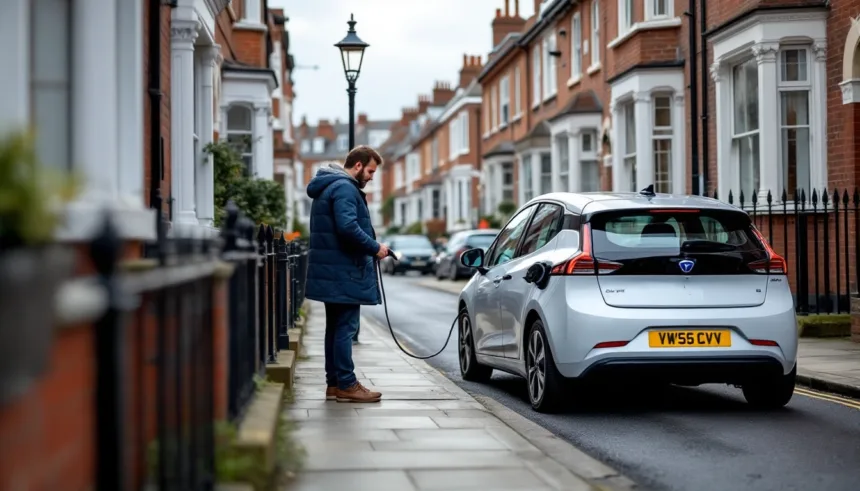
More than a third of UK households lack off-street parking, yet electric vehicle ownership continues to climb. If you’re wondering whether you can charge an EV without a driveway in the UK, the short answer is yes, but it requires a different approach than the plug-in-and-forget convenience of a home wallbox.
- Can you charge EV without driveway in the UK?
- Ways to charge EV without driveway UK: quick map
- Kerb-safe home solutions for terrace and flats
- On-street and lamppost chargers on your road
- Using public rapid hubs as your ‘virtual driveway’
- Workplace, supermarkets and charger sharing
- Rules, safety and UK council permissions
- Costs: home-style vs on-street vs rapid charging
- Is an EV worth it without a driveway?
- Frequently Asked Questions
You’ll rely on a combination of on-street charge points, workplace or destination charging, and occasionally public rapid hubs, all while navigating council planning rules, pavement safety laws, and the real cost per mile of each option. This guide compares the practical solutions available to terrace, flat, and street-parked residents across the UK (with a brief look at Germany for context).
You’ll see what kerbside charging infrastructure exists today, how to apply for a council-installed post, whether trailing a cable is ever legal, and how to layer smart tariffs and home energy monitoring into a no-driveway routine.
Can you charge EV without driveway in the UK?
Yes, you can charge an EV without a driveway in the UK, but it works best if you treat charging like planning your weekly fuel stops rather than “plug in every night at home”. The realistic options combine pavement-safe home solutions, public infrastructure and smart tariffs, and they suit some lifestyles far better than others.
The main home-adjacent option for people who want to charge EV without driveway UK is a managed kerbside connection: a cable-through-gully system or purpose-built product (for example, a channel cut in the pavement by the council, or a slim kerbside unit that connects back to your fuse box). These can be practical on quieter residential streets, but they almost always need local authority permission and strict cable management to stay legal and safe.
If that’s not viable, you’re relying on shared infrastructure: public on-street chargers, lamppost chargers, car-park hubs, workplace charging and, in flats, shared or allocated bays with charge points. This setup works well if you have predictable parking, live near a cluster of chargers, or regularly access charging at work or a supermarket.
Related internal resource EV charger no garage Germany.
Ways to charge EV without driveway UK: quick map
If you want to charge EV without driveway UK, you effectively mix several on-street, shared and workplace options. The table below sketches real-world costs and who each route best serves so you can plan a workable mix rather than rely on a single solution.

| Option | Typical cost/kWh | Setup cost | Best for |
|---|---|---|---|
| Cable across pavement with channel | ~30p (home tariff) | £200-£1,000 | Terraces with nearby kerb space |
| On-street or lamppost charger | 40-60p | Usually £0 | Streets with council rollout |
| Community or local charging hub | 45-70p | £0 | Areas near retail or car parks |
| Workplace charging | Free, 35p | £0 to driver | Regular commuters with parking |
| Neighbour or driveway sharing | 25-40p | £0-£200 (app/hardware) | Good neighbour ties, sparse public charge |
Drivers without off-street parking usually combine two or more of these: for example, cheap overnight charging at a lamppost charger plus occasional rapid top-ups on motorway corridors at 60-85p/kWh. When comparing ways to charge an EV without a driveway in the UK, factor in not just pence per kWh but how predictably you can park, whether you can leave the car overnight, and any council rules on cables or kerb modifications.
Related internal resource EV charging speeds explained home.
Kerb-safe home solutions for terrace and flats
For UK residents trying to charge an EV without a driveway, kerb-safe systems aim to mimic home charging while keeping pavements usable. Instead of trailing a loose cable across the footpath, they create a protected route from your home supply to the roadside, usually via a recessed channel or lockable gully.
Products like Kerbo Charge and Gul-e sit flush in the pavement or verge. An installer cuts a narrow trench, fits the unit, and reconnects the surface so pedestrians, wheelchairs and prams can pass safely. You then run your own cable through the channel from a wall-mounted charge point or outdoor socket to the car at the kerb, removing it when not in use. Some councils instead trial simple cross-pavement ducts or rubber cable protectors as a cheaper, semi-permanent option.
Council attitudes vary sharply. A few local authorities are actively piloting Kerbo Charge- or Gul-e-style solutions and may part-fund installs through on-street charging budgets. Others reject any private kit in the public highway on liability or accessibility grounds and will only back public chargers or lamp-post units. Permission usually hinges on local Highways policy, conservation rules, and whether the pavement is wide enough for safe clearance.
Costs range widely: expect roughly £800-£1,500 for a kerb channel plus a basic home charge point, depending on civil works and whether the council shares costs. Pros include lower per-kWh prices similar to normal home charging, reduced trip risk versus loose cables, and predictable overnight availability.
On-street and lamppost chargers on your road
For many people trying to charge an EV without driveway UK streets, on-street and lamppost chargers are the most realistic long-term solution. They let you plug in close to home without trailing cables over the pavement and are growing quickly across UK cities, suburbs and some villages.
Lamppost chargers are usually 3-5.5 kW units wired into existing street lighting columns, while kerbside bollards or pillar chargers are often 7-22 kW. That means a typical overnight top-up adds roughly 40-120 miles, depending on your car and the kW rating. Tariffs are usually pay-as-you-go via app or RFID card; costs often sit between ~45-75p/kWh, so not as cheap as a driveway home charger but still well below most rapid chargers.
| Charger type | Power | Typical cost | Best for |
|---|---|---|---|
| Lamppost | 3-5.5 kW | 45-65p/kWh | Overnight top-ups |
| Kerbside bollard | 7 kW | 45-70p/kWh | Regular local use |
| On-street fast | 11-22 kW | 50-75p/kWh | Shorter stops |
To find chargers already on your road or nearby, use national maps like Zapmap or your energy supplier’s app if they operate public charge points. Filter by “on-street” or “lamppost” and save your closest, cheapest options. Many UK councils list current and planned charge locations on their websites; some, such as those using the ORCS or LEVI funding schemes, also run resident surveys asking where new points are most needed.
If your street has no infrastructure yet, look for a “request an EV charger” form on your council’s transport or sustainability pages. You’ll usually be asked about your address, car ownership, parking patterns and demand from neighbours.
Using public rapid hubs as your ‘virtual driveway’
You can effectively replace a driveway in the UK by treating rapid public charging hubs as a “virtual driveway”. Instead of plugging in nightly, you plan 1-3 focused sessions a week at GRIDSERVE, motorway services, supermarket rapids or city hubs. This suits drivers who can’t charge EV without driveway UK access, especially if you drive moderate mileage and pass a hub on regular routes.
| Charger type | Typical price/kWh | Approx cost/mile | Good for |
|---|---|---|---|
| Home off-peak | 10-15p | 3-5p | High annual miles |
| Home standard | 25-30p | 7-9p | Most homeowners |
| Public rapid | 60-75p | 15-22p | No driveway users |
| Petrol | , | 18-25p | Mixed driving |
| Diesel | , | 20-28p | Long motorway runs |
For many EVs, rapid charging now costs roughly similar per mile to a petrol hybrid, and sometimes less than pure petrol or diesel, depending on efficiency and energy prices. The trade-off is time: a typical 20-80% rapid charge takes around 20-40 minutes. You minimise inconvenience by synchronising charging with other stops, weekly grocery shops, gym visits, school runs, or coffee breaks on your commute.
This “virtual driveway” model works best if you: live within 5-10 minutes of at least one reliable rapid hub; drive under roughly 12-15k miles a year; and can comfortably batch charging into one or two planned sessions. Higher-mileage drivers may still manage, but you’ll visit hubs more often and pay a clear premium versus home tariffs.
Workplace, supermarkets and charger sharing
When you can’t charge an EV at home without a driveway, workplace and shared charging infrastructure becomes essential. Many UK employers now offer free or subsidised workplace chargers; check your HR portal or facilities team for availability, booking systems, and whether you can leave your car plugged in all day. Workplace charging typically delivers 7 kW, adding 25-30 miles per hour, enough to top up during an eight-hour shift. If your employer doesn’t yet provide chargers, a formal request citing the growing demand for workplace EV infrastructure can accelerate installation.
Supermarkets, retail parks, and leisure centres increasingly install free or low-cost rapid chargers (7-22 kW) in car parks. Tesco, Sainsbury’s, Lidl, and IKEA partner with Pod Point and Ubitricity to offer charging while you shop; sessions often cost 20-30p per kWh, competitive with public networks. Plan weekly grocery trips around charging stops, aiming for 30-60 minutes to add 60-120 miles. Download apps like Zap-Map to filter by free or low-cost chargers near your regular routes.
Peer-to-peer charger sharing platforms, Co Charger, JustPark Electric, and Bookmycharge, let you rent a neighbour’s driveway charger by the hour or month. Typical rates run £2-£5 per session or £30-£60 monthly for regular access.
Rules, safety and UK council permissions
If you want to charge an EV without a driveway in the UK, the main barriers are legal duties to keep pavements safe and clear. Councils are responsible for public highways, and most treat loose or trailing cables across the footway as an obstruction and trip hazard. Many publish explicit rules banning cable protectors and home-made ramps on pavements, even if they only appear overnight, because you could be liable if someone trips, a buggy can’t pass, or a wheelchair user is forced into the road.
Even where there is no written ban, UK law expects you to avoid creating foreseeable risks on public land. If you run a cable from your home to the kerb, you may be held responsible for injury or damage, and your home insurer might refuse a claim. That is why the safest assumption is that you cannot legally charge by trailing a cable across the pavement unless your council has installed an approved, permanent crossing system.
Instead, many councils are trialling or approving kerbside solutions: lamp-post chargers, bollard chargers, gully systems that recess a cable through the pavement, and dedicated on-street EV bays.
Costs: home-style vs on-street vs rapid charging
Charging an EV without a driveway in the UK rarely means one single solution. Costs shift a lot depending on whether you can mimic “home” charging via a kerbside setup and off-peak tariff, rely mostly on public on-street points, or lean on rapid hubs for convenience. The spread typically runs from ~7-10p per mile with smart home-style charging to 20-40p+ per mile using rapids.
To show the gap, assume a reasonably efficient EV using 3.5 miles per kWh. Prices are typical UK figures in 2024, but local networks and tariffs vary, so always check current rates before deciding how to charge EV without driveway UK.
| Scenario | Price / kWh | Cost / mile | Notes |
|---|---|---|---|
| Home-style off-peak (kerb) | 10-15p | 3-4p | Smart EV tariff |
| Standard domestic rate | 25-30p | 7-9p | Daytime usage |
| On-street lamppost | 45-55p | 13-16p | Pay-as-you-go |
| Rapid hub (50-150kW) | 65-80p | 19-23p | Motorway/retail sites |
| Discounted rapid membership | 50-60p | 14-17p | Prepaid / subscription |
If you can’t park on your own property but have a regular kerbside space, a council-approved channel across the pavement, gulley system, or dedicated kerbside charger plus a smart tariff often comes within a few pence per kWh of “normal” home charging. Combined with automated or AI-based scheduling (for example via your supplier app or vehicle software that only charges in cheap windows), this keeps cost per mile close to the 3-5p range.
Drivers who rely on public on-street chargers see running costs roughly double versus off-peak home-style charging, though still below petrol per mile for most use cases.
Is an EV worth it without a driveway?
Whether an EV is worth it without a driveway in the UK or Germany depends less on where you park and more on your driving pattern, local charging options, and electricity prices. For many low- and medium-mileage drivers in cities and large towns, public and on-street charging now makes ownership practical, though not always as cheap or convenient as having a home charger.
Think about four core factors before you decide:
- Annual mileage: Below ~8,000 miles a year, public and on-street chargers usually work fine; over ~12,000 miles, the time and price premium over driveway charging become more noticeable.
- Where you live: UK terraced streets with new lamp-post or curbside chargers, and dense German cities with strong public networks, suit EVs better than rural areas with only a few fast chargers.
- Parking reality: If you regularly park on the same stretch of road, you can plan around nearby chargers or cable-gully solutions; if you circle for 20 minutes most evenings, relying on a specific charger will be stressful.
- Electricity vs fuel costs: Off-peak EV tariffs and slower on-street chargers are usually cheaper per mile than petrol or diesel; rapid chargers in motorway or premium city locations narrow that gap.
Frequently Asked Questions
Can I charge my EV without a driveway?
Yes, you can charge an EV without a driveway in the UK, but it takes planning. Main options are: kerb channels or cable gulleys where councils allow trailing a cable; lamppost and bollard chargers on your street; local public rapid hubs; and workplace charging.
How to charge EV if no driveway?
Start by mapping every charger within walking distance using apps like Zapmap or PlugShare. Check if your council supports kerbside solutions, such as cable channels or on-street chargers.
Combine these with workplace, supermarket, and gym charging where possible.
Is an EV worth it if I don’t drive much?
For low-mileage drivers who charge EV without driveway UK, it depends on local tariff costs and access to cheap charging. You save on servicing, road tax and ULEZ, but pay more per kWh if you rely on rapid or public chargers.
What is the first step in charge EV without driveway UK?
The best first step to charge EV without driveway UK is to audit your local options. Before buying or leasing, use a charging app to see how many chargers you can comfortably walk to, when they’re busy, and what they cost.
How do homeowners know whether charge EV without driveway UK is worth it?
Compare your current fuel cost per mile with a realistic electric cost per mile using only chargers you can access without a driveway. Factor in parking, ULEZ, and tax savings, and whether you can reliably park near lamppost or public chargers.
Charging an EV without a driveway in the UK is entirely feasible if you live near reliable on-street points, work somewhere with daytime charging, or can adapt your routine around weekly top-ups at rapid hubs. The key is honest mileage arithmetic: calculate your weekly kWh need, map the nearest public or council chargers, and compare the blended cost per mile against petrol.
If your street qualifies for a residential charge-post scheme and you drive fewer than 200 miles a week, the switch often pencils out within the first year. For higher-mileage drivers or streets with zero infrastructure, a plug-in hybrid or continued ICE ownership may still be the pragmatic choice until your council’s rollout catches up.