




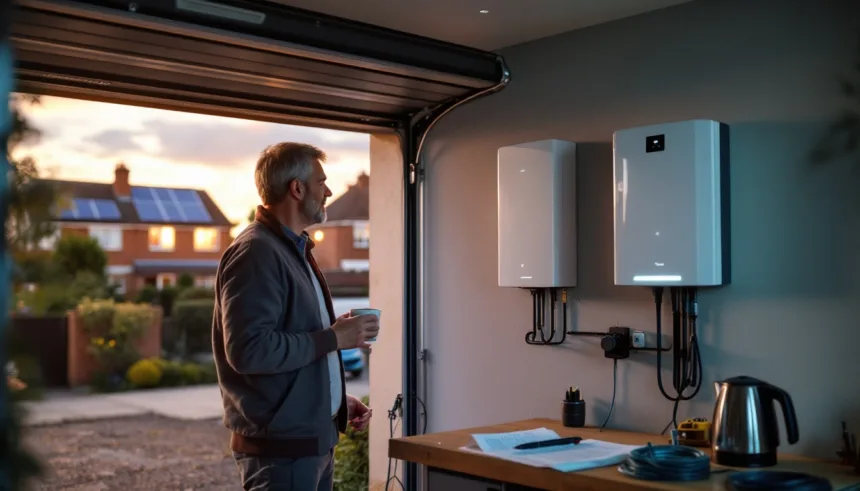
A home battery saves money by storing electricity when it’s cheap, or free from your solar panels, and releasing it when grid prices are high. For a typical UK household on a time-of-use tariff, that can mean £300-£700 a year in bill savings; German homes on dynamic or dual-rate contracts see similar gains of €350-€800 annually.
- How a home battery actually saves you money
- How home battery saves money with solar power
- Cutting bills with off-peak charging and smart tariffs
- Working out if a home battery is worth it for you
- How capacity, power rating and efficiency affect savings
- Real-world examples from UK and German homes
- Smart controls, AI and avoiding common money-losing mistakes
- Support, incentives and what might change your payback
- Frequently Asked Questions
The mechanics are straightforward: charge during off-peak hours or sunny afternoons, discharge during evening peaks, and avoid buying expensive grid power. Yet the real payback depends on your tariff structure, daily consumption profile, solar generation (if any), and upfront cost.
This guide explains exactly how home batteries turn rate arbitrage and solar self-consumption into cash savings, then gives you a step-by-step framework to estimate your own annual benefit and realistic payback period using real UK and German tariff numbers.
How a home battery actually saves you money
At its core, a home battery saves money in two ways: it buys electricity cheaply (or stores your own solar) and feeds it back to your home when power is expensive. This is the real answer to how home battery saves money, whether you are on a UK time-of-use tariff or a German solar feed-in setup.

First, time-of-use arbitrage: in the UK, a typical semi-detached home on a smart tariff might pay about 14-18p/kWh off-peak at night and 30-40p/kWh in the evening peak. A 10 kWh battery charged at 16p and discharged instead of buying at 34p effectively “earns” around 18p for each kWh cycled. If you use 7 kWh of that storage on a typical winter day, that is roughly £1.25/day or about £450/year, before efficiency losses and standing charges are considered.
Second, maximising self-consumption of solar: in Germany, a detached house with a 7 kW PV system might often export surplus at around €0.08-0.10/kWh while paying roughly €0.30-0.35/kWh to buy electricity from the grid.
Related internal resource home battery sizing guide kWh.
How home battery saves money with solar power
Understanding how home battery saves money with solar starts with where each kilowatt-hour (kWh) goes. Without a battery, daytime solar that you do not use immediately is exported to the grid for a modest payment. With a battery, more of that surplus is stored and used later, displacing expensive evening grid imports.
In the UK, a typical smart export guarantee (SEG) rate is around 5-15p/kWh, while flexible import tariffs often sit around 25-30p/kWh. In Germany, many homes with older feed-in contracts still earn roughly 7-9 euro cents/kWh, but buy power back for around 30-35 euro cents/kWh. The spread between low export income and high import cost is exactly where a home battery creates extra value.
Instead of exporting excess solar, a battery charges during sunny hours and then covers your evening and early-morning demand. That replaces units you would otherwise buy from the grid at full retail price. Each shifted kWh is now worth the import price rather than the export price, so the gain is the difference between the two.
The numbers below show how this plays out for one stored kWh of solar energy in both countries.
| Country | Import price/kWh | Export price/kWh | Extra saving per stored kWh |
|---|---|---|---|
| UK | 28p | 8p | 20p |
| Germany | 32c | 8c | 24c |
Related internal resource what is a home battery.
Cutting bills with off-peak charging and smart tariffs
Home batteries cut bills by “buying” electricity when it’s cheap and “spending” it when grid prices are high. With off-peak and dynamic tariffs, this arbitrage can be worth more per kWh than many rooftop solar exports, which is why understanding how home battery saves money under these tariffs matters as much as the hardware itself.
On a UK EV or Economy 7, style tariff, you might pay ~9p/kWh between 00:30-04:30 and ~30p/kWh in the evening peak. A 10 kWh battery charged fully at night and used entirely during peak hours displaces roughly 10 × (30p − 9p) = £2.10 of grid costs per day. Accounting for 90% round-trip efficiency, you only get 9 kWh back, dropping daily savings to about £1.89, or ~£690/year if repeated every day. Dynamic tariffs like Octopus Agile vary hourly; on windy nights prices can be near 0p or occasionally negative, so smart controllers charge your battery when prices are lowest, often beating standard off-peak deals over a year.
In Germany, dynamic tariffs track wholesale prices with similar patterns: cheaper overnight and on very windy or sunny days, expensive on winter evenings.
| Country | Cheap rate | Peak rate | Net saving/kWh |
|---|---|---|---|
| UK | 9p | 30p | ~19p before losses |
| UK | 0-5p | 25-35p | 20-30p dynamic |
| Germany | €0.18 | €0.38 | €0.20 before losses |
| Germany | €0.10-0.20 | €0.30-0.45 | €0.15-0.25 dynamic |
| Both | 90% efficient | , | ~10% less in reality |
Working out if a home battery is worth it for you
To decide if home battery storage is worth it, start with your current bills and tariffs, then map how a battery could shift when you buy and sell electricity. The goal is to see whether time-of-use arbitrage and captured solar would realistically beat the battery’s annual cost.
| Factor | Typical UK | Typical Germany | Why it matters |
|---|---|---|---|
| Installed cost | £4k, £8k | €5k, €9k | Sets payback length |
| Annual bill | £800-£2,000 | €1,000-€2,200 | Caps savings ceiling |
| Solar size | 2-6 kWp | 5-10 kWp | Drives surplus energy |
| Export price | 5-20 p/kWh | 6-12 c/kWh | Benchmark vs storing |
| TOU spread | 10-30 p/kWh | 8-20 c/kWh | Arbitrage potential |
Use this quick checklist to judge value:
- Installed quote (battery + install) ÷ 10 gives a rough annual saving you need to hit for a 10-year payback.
- Estimate kWh the battery can realistically cycle daily (often 0.6-0.8 of usable capacity) from either solar surplus or cheap night import.
- Multiply those kWh by your effective gain per kWh: peak tariff minus off-peak, or import rate minus export rate.
- Annual saving = daily saving × 365, then compare with required saving from the first step.
- Aim for payback under 8-12 years and lifetime ROI above 30-50% to justify the upfront cost for most homes.
How capacity, power rating and efficiency affect savings
To understand how home battery saves money in practice, you need to match capacity (kWh), power rating (kW), efficiency and expected degradation to your tariff and usage profile. Oversizing pushes payback out; undersizing leaves cheap or free energy unused.
Capacity (kWh). A simple rule of thumb: aim for a battery that can cover your typical evening and early-morning use that isn’t already met by solar. In the UK, many 3-4 person homes land around 5-10 kWh; in Germany with higher winter heating loads (e.g., heat pumps), 8-12 kWh is more common. If your solar rarely exports, a smaller battery usually makes more sense; if you export heavily, you can usually justify more capacity. Our home battery sizing guide kWh walks through this with worked examples.
Power rating (kW). This limits how quickly the battery can charge from cheap or solar power and how much of your peak demand it can cover.
Real-world examples from UK and German homes
Understanding how home battery saves money becomes clearer when you examine real households. Below are three representative scenarios from the UK and Germany, each illustrating different usage patterns, system configurations, and financial outcomes. These examples use typical tariff rates, consumption profiles, and equipment costs observed in 2023-2024.
| Scenario | System | Annual consumption | Battery size | Total cost | Annual saving | Simple payback |
|---|---|---|---|---|---|---|
| UK solar + battery Semi-detached, 4 kWp solar, Octopus Flux | 5 kWh battery, AC-coupled inverter | 3,800 kWh | 5 kWh usable | £4,200 | £520 | 8.1 years |
| UK off-peak only Flat, no solar, Octopus Go | 5 kWh battery, standalone | 2,600 kWh | 5 kWh usable | £3,800 | £310 | 12.3 years |
| German solar + heat pump Detached, 8 kWp solar, dynamic tariff | 10 kWh battery, DC-coupled | 6,200 kWh (incl. heat pump) | 10 kWh usable | €8,500 | €780 | 10.9 years |
In the first case, a UK household with existing rooftop solar added a 5 kWh battery to capture surplus daytime generation and shift it to evening peaks.
Smart controls, AI and avoiding common money-losing mistakes
Smart controls are what turn a battery from a nice gadget into a tool that actually cuts bills. Modern systems monitor prices, solar output and your use pattern, then decide when to charge and discharge. Instead of guessing, the software learns when your home needs power and when the tariff is cheap, so the battery sells every kWh it stores at the highest avoided price it can.
To make this work, link the battery app to your time-of-use tariff and, where available, enable “economic mode”, “smart mode” or an AI optimiser. These modes usually: prioritise charging from cheap off-peak or excess solar; hold back a reserve for predictable peaks (breakfast and evening); and adjust seasonally, discharging more on winter evenings and less on long summer days. Review the schedule after any tariff change, new EV or heat pump, or a major lifestyle shift.
Several common mistakes quietly kill savings.
Support, incentives and what might change your payback
Support for home batteries is evolving, and it directly shapes your payback. In the UK, there is currently no nationwide grant just for batteries, but you do benefit from 0% VAT when a battery is installed at the same time as solar (and, from 2024, often even when retrofitted). That cuts upfront cost by 5-20% depending on system size. Some local or time-limited schemes appear via councils or network trials, so it is worth checking regional offers before you finalise a quote.
Germany has moved away from broad national grants and instead relies heavily on state-level programmes. Several Bundesländer periodically offer low-interest loans or partial subsidies for PV plus storage, but funding windows open and close quickly. Grid-friendly operation can also matter: if you agree to let the grid operator control a small part of your battery capacity, you may access better tariffs or one-off support, though terms differ widely and should be read closely.
Wholesale and retail electricity prices in both countries are volatile. A home battery can save more money when price spreads between cheap and expensive hours are large, or when solar export rates are low compared to import prices.
Authoritative resource: Is solar battery storage worth it?.
Frequently Asked Questions
Can a home battery save money?
Yes, a home battery can save money, but the amount varies. In the UK, typical savings are roughly £200-£600 per year; in Germany, about €200-€700, assuming sensible sizing.
How much you save depends mainly on solar output, time-of-use tariffs, your day-evening usage split, and battery capacity relative to your normal consumption.
Is home battery storage worth the cost?
Home battery storage is often worth it when you have solar, good self-consumption potential, and access to time-of-use or dynamic tariffs. Simple payback is commonly 8-15 years; faster for high evening use and strong tariffs, slower for low use.
How much should a 10kWh battery cost?
A 10kWh battery typically costs about £5,000-£8,000 installed in the UK and around €7,000-€10,000 in Germany, depending on brand, inverter needs, labour, and complexity. To pay back, you’d usually need annual bill savings of roughly £350-£700 or €400-€800, which means using time-of-use tariffs and solar generation efficiently over the system’s life.
How to maximize home battery life?
To maximise battery life and long-term savings, avoid running it to 0% or 100% daily; aim for 20-80% where possible. Keep the unit in a cool, dry, ventilated space.
How long will a 10kWh battery last?
A 10kWh battery can typically power 1-2kW of continuous household load for 5-10 hours, depending on what’s running. Most systems are warranted for about 6,000-10,000 cycles or 10-15 years to around 60-80% of original capacity.
Understanding how a home battery saves money comes down to three levers: capturing cheap or free electricity, avoiding expensive peak rates, and maximising solar self-consumption. Use the step-by-step framework above, map your tariff, calculate daily arbitrage, add solar gains, subtract losses, and divide hardware cost by net annual savings, to estimate your payback period.
For most UK and German homes with time-of-use tariffs or rooftop solar, a correctly sized battery pays for itself in six to ten years and delivers decades of bill relief. Run your own numbers, compare quotes, and remember that tariff choice matters as much as the battery itself.