




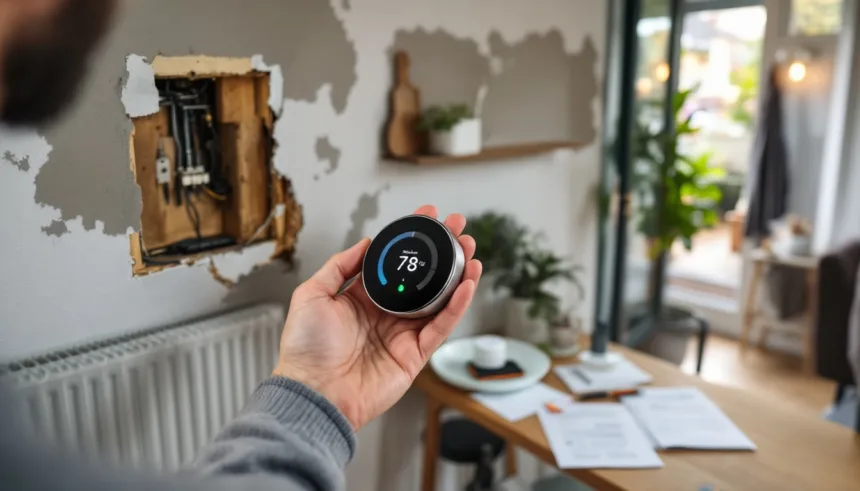
If you’re weighing a Nest vs tado Germany comparison in 2026, the first thing to know is that Google Nest thermostats are no longer officially sold or supported in Germany or most of mainland Europe. That changes the decision significantly: while tado remains the dominant smart thermostat across German homes with native support for condensing boilers, multi-zone control, and local customer service, Nest is now primarily a UK-market product with limited grey-market availability in the EU.
- Nest vs tado in Germany: the short answer
- Nest vs tado Germany comparison on availability and support
- Compatibility with German and UK heating systems
- Smart features, AI and comfort differences
- Room-by-room control and radiator thermostats
- Upfront cost, subscriptions and real savings
- Data, privacy and long-term support risks
- Which homes benefit more from tado or Nest
- Best alternatives now Nest is fading in Europe
- Frequently Asked Questions
This guide explains what happened to Nest in Europe, how tado’s feature set and real-world energy savings stack up, when a Nest setup still makes sense for UK users, and which alternatives German homeowners should consider if tado’s subscription model or price point doesn’t fit. Whether you’re upgrading an older heating system or building out a smart home from scratch, understanding compatibility, ongoing costs, and actual heating-bill impact matters more than brand recognition.
Nest vs tado in Germany: the short answer
For a Nest vs tado Germany comparison, the crucial detail is this: Google no longer officially sells or promotes Nest thermostats in Germany or most of mainland Europe. Stock is effectively legacy, new features are focused on a few core markets (notably the US and UK), and long-term support in Germany is uncertain. By contrast, tado is designed, sold, and supported in Europe, with localised hardware, zoning, and energy-saving tools built around German-style heating systems.
If you are installing a new smart thermostat in Germany today, tado (or another Europe-first brand) is the practical default. It supports common German boiler systems, district and apartment heating, and, critically, room-by-room control via smart radiator valves. That zoning is where most real savings come from in European homes. You also keep full access to local customer support and ongoing software updates.
More Read

Where Nest still makes sense is mainly the UK and a few remaining supported markets. There, Nest can work well in simple, single-zone boiler setups and Google-centric smart homes, especially when paired with other Nest and Google products. But if you live in Germany and are weighing Nest vs tado, treating Nest as a long-term, future-proof option is risky; you would be betting on a product line Google has already pulled from your market.
Related internal resource do smart thermostats save money UK.
Nest vs tado Germany comparison on availability and support
Nest vs tado Germany comparison starts with a simple reality: Google no longer officially sells Nest thermostats in Germany or most of mainland Europe, while tado is actively marketed, supported and updated across the DACH region and wider EU. You can still import a Nest from other markets or buy old stock, but you are effectively running a discontinued product line in this region.
In the UK, both Nest and tado remain current options, with localised support and installers. In Germany, tado is the clear default for a new smart thermostat because its apps, documentation, wiring guides and customer service are tailored to German boilers, district heating and multi-flat buildings, and its cloud services are hosted and supported for EU customers.

| Aspect | Nest Germany | Nest UK | tado Germany |
|---|---|---|---|
| Official sales | No | Yes | Yes |
| Warranty path | Import only | Local | Local/EU |
| Language support | Limited | Full EN | DE + EN |
| Installer network | Unofficial | Established | Established |
| Future-proofing | Uncertain | Moderate | Strong |
Existing German Nest users can generally keep using their thermostat as long as Google maintains cloud services and app logins; over-the-air updates may continue, but there is no guarantee of long-term feature development or EU-specific adaptations. Hardware repairs under warranty can also be awkward if the device was imported.
Related internal resource best AI smart thermostat UK 2026.
Compatibility with German and UK heating systems
Nest and tado take very different approaches to compatibility, which really shows in a Nest vs tado Germany comparison. Nest was designed first for simple US-style on/off boiler control; tado was built around European boilers, underfloor loops and radiator circuits from the start. In practice, tado usually integrates more cleanly with German heating systems, while Nest remains solid for straightforward UK combi or system boiler setups.
Most German homes use wall-hung gas boilers, district heating or heat interface units, plus room thermostats and often underfloor heating. tado supports many of these via on/off relay and common European bus protocols such as OpenTherm on compatible boilers, giving finer modulation and steadier indoor temperatures. Nest supports OpenTherm as well, but the feature is only enabled with specific third-generation hardware and isn’t officially tailored to the wide mix of German brands and installers now face reduced local support because Nest is no longer officially sold in most of Europe.
In the UK, where combi and system boilers with simple call-for-heat wiring are normal, both systems usually work. Nest Heat Link or Nest Learning Thermostat can slot into a standard 2-channel programmer and room stat wiring, and it handles hot-water control on many setups. tado matches this, but adds granular multi-zone and per-radiator control via its smart TRVs, which is also valuable in many German apartments with shared boilers where you only control individual radiators. This zoning flexibility is one of the biggest real-world differences in daily use.
| Setup type | Nest fit | tado fit | Notes |
|---|---|---|---|
| UK combi boiler | Very good | Very good | Simple wiring |
| German gas boiler | Good | Excellent | Better bus support |
| District heating | Limited | Good | Check valves |
| Underfloor heating | Basic | Stronger | More zoning |
| Multi-zone TRVs | Partial | Excellent | Per-room control |
Smart features, AI and comfort differences
Nest vs tado Germany comparison discussions usually start with how “smart” each system actually feels. Both can cut wasted heating, but they approach AI and automation differently, which matters for comfort, control and compatibility in Germany and the UK.
| Area | Nest | tado |
|---|---|---|
| Core logic | Learning schedule | Rules + geofencing |
| Geolocation | Household presence | Per-phone geofencing |
| Apps | Google Home focus | Heating-focused app |
| Voice | Best with Google | Google, Alexa, Siri |
| Zoning | Limited, DIY | Deep radiator zoning |
Nest’s defining feature is its learning schedule: you turn the dial up and down for a week or two, and it builds an automatic routine. It also uses presence detection (motion sensor plus phone location in supported regions) to switch between Home and Away. This suits UK homes with a fairly regular pattern and one main thermostat controlling the boiler. In daily use, many people barely touch the app once Nest has learned, but manual fine-tuning can feel slower because you are nudging a learned pattern rather than explicit rules.
tado is more rules-driven. You set clear schedules per room, then add geofencing and “open window” detection on top. The app is built around heating management, so you see room-by-room targets, current temperatures and manual boosts at a glance. For German apartments with many radiators and mixed schedules (home office, children’s rooms, guest room), this per-room logic usually feels more transparent than Nest’s single-learning brain.
Room-by-room control and radiator thermostats
For a Nest vs tado Germany comparison, zoning is where the two systems diverge sharply. German homes often have boiler-based central heating with radiators in every room, and owners increasingly expect room-by-room control. tado is designed exactly for this style of system, while Nest’s zoning in Europe is more limited and usually depends on extra hardware or third-party radiator valves.
| Feature | tado | Nest | Impact |
|---|---|---|---|
| Native TRVs | Yes, own brand | No | Simpler full-room control |
| Room zoning | Per-room schedules | Mainly whole-home | Higher comfort, less waste |
| Radiator focus | Core design | Add-on via others | Better fit for flats |
| German support | Actively sold | Official sales paused | Long-term parts, help |
| Install complexity | Modular, TRV by TRV | Depends on extras | tado usually easier |
tado’s smart radiator thermostats (TRVs) replace existing manual heads, so you can start with key rooms (living room, home office, nursery) and expand later. Each TRV can have its own schedule, geofencing rules, and open-window detection, making it well suited to German apartments with no central wall thermostat. The system talks directly to compatible boilers or uses a simple on/off relay, and the app groups devices logically into rooms and zones.
By contrast, Nest in Europe is built around a central thermostat and Heat Link at the boiler. You can add independent smart TRVs from other brands, but they won’t integrate tightly with Nest’s learning algorithms or schedules.
Upfront cost, subscriptions and real savings
In a Nest vs tado Germany comparison on savings, the first reality check is availability: new Google Nest thermostats are no longer officially sold in Germany, so any Nest pricing is effectively grey-import or legacy stock, while tado is fully supported and widely distributed across Europe. That affects not just purchase price but also future support, warranty, and integration with German heating systems.
| System | Starter kit price | Extras | Typical install |
|---|---|---|---|
| tado (wired) | €150-€220 | TRVs ~€60/pair | DIY or €100-€200 |
| tado (wireless) | €220-€300 | TRVs ~€60/pair | €150-€250 |
| Nest (legacy) | ~€200-€260 | Extra Heat Link | €150-€250 |
| Cheap Wi-Fi stat | €60-€120 | None | €80-€150 |
| Pro install bundle | €350-€600 | Room sensors/TRVs | Included |
tado’s business model in Germany mixes one-off hardware with optional subscriptions. Core features like app control, schedules, multi-room zoning and geofencing work without paying monthly. The paid “Auto-Assist” tier (often ~€3-€5/month or ~€25-€30/year on offers) simply automates certain prompts, such as switching off when everyone leaves or when an open window is detected. Over a decade, that can add a non-trivial €250-€300 if you keep it permanently, so many owners only subscribe in the first couple of winters or cancel after fine-tuning schedules.
Nest has no ongoing subscription for basic thermostat features, but in Germany you typically lose access to the fuller smart-home ecosystem that exists in supported markets, and some utility-linked demand-response or boiler-optimisation programs are not available. That weakens the long-term value case versus a fully-supported tado setup that is tailored to European radiator and boiler systems and frequently discounted in German retail channels.
Data, privacy and long-term support risks
For a Nest vs tado Germany comparison, data and long-term support are where the differences matter as much as features. Both are cloud-first platforms, but they sit in very different regulatory and business contexts.
Google Nest requires a Google account and runs on Google’s global cloud stack. Data from your thermostat, app usage and, if present, other Google devices can be linked to your wider profile for product improvement and personalised services. Google states that smart-home data is handled under GDPR for EU/UK users, with hosting and processing aligned to European rules, but enforcement ultimately relies on large cross-border infrastructure. If Google ever de-prioritises Nest in mainland Europe (as already seen with reduced sales and feature localisation), you are dependent on a very big, very generalist ecosystem continuing to care about a relatively small EU smart-heating segment.
tado, by contrast, is a Germany-founded company with infrastructure and policies designed from the outset for EU markets.
Which homes benefit more from tado or Nest
Choosing between Nest and tado depends heavily on your property type, heating system, and where you live. In Germany, tado is the clear winner for most scenarios because Google no longer officially sells or fully supports Nest thermostats across most of mainland Europe, leaving German buyers without local warranty, customer service in German, or guaranteed compatibility with regional heating standards.
For a small German flat with radiator heating, tado’s multi-zone radiator thermostats shine. You can control individual rooms independently, avoiding the waste of heating unused spaces, ideal for one- or two-bedroom apartments where zoning matters more than whole-home learning algorithms. Nest’s single-zone approach would heat the entire flat uniformly, negating potential savings.
In a larger UK semi-detached home with a combi boiler, Nest remains a solid choice if you value simplicity and already use Google Home devices. Its learning algorithm adapts to your schedule without manual programming, and UK support remains robust. However, tado’s room-by-room control still offers superior efficiency if you have unused bedrooms or a home office with irregular occupancy.
For heat-pump-ready homes , tado provides explicit heat-pump compatibility and weather-compensation features that optimize low-temperature heating cycles.
Best alternatives now Nest is fading in Europe
For a clear Nest vs tado Germany comparison, start with availability: Google no longer officially sells Nest thermostats in most of Europe, including Germany, which means no local support, patchy compatibility information, and extra friction sourcing hardware. Tado, by contrast, is designed for European heating systems, with strong German-language support and radiator-zoning gear that works well in apartments and multi-room homes.
In the UK, Nest can still be a sensible choice if you already own a unit, want deep Google ecosystem integration (Nest Hub, voice control, presence detection via Google accounts), and have a straightforward combi boiler. It is less ideal for complex zoning or homes that rely heavily on radiator thermostats. In Germany and much of mainland Europe, tado is usually the safer main recommendation because it supports more boiler brands, heat pumps, and district heating, and the ecosystem of smart radiator valves is more mature.
Alongside this Nest vs tado Germany comparison, it is worth considering 1-2 strong alternatives that keep pace with AI-driven control. For German and UK homes, brands like Homematic IP (very zoning-friendly in Germany) and Hive (UK-focused, works well with British boilers) can be compelling if you prefer not to rely on Google or subscription add-ons.
| Option | Best region | Strength | Watch out for |
|---|---|---|---|
| tado | Germany, UK, EU | Zoning, radiator valves | Some features subscription |
| Nest | UK, legacy EU | Google ecosystem | No official Germany sales |
| Homematic IP | Germany | Advanced zoning | Less English support |
| Hive | UK | Simple boiler control | Limited EU presence |
Authoritative resource: Best Smart Thermostat UK: Nest vs Hive vs Tado.
Frequently Asked Questions
Is tado a German company?
Yes. tado° was founded in Munich and is headquartered in Germany, which helps for German homeowners: the app, documentation and support are available in German, products are designed around common German heating setups, and they follow EU and German regulations.
Why is Google discontinuing Nest?
Google has largely stopped selling Nest thermostats in Germany and much of Europe, reportedly to focus on newer Google Home products and simplify its regional portfolio. Existing devices still receive updates and support.
Is tado the same as Nest?
No. Nest and tado° are both smart thermostats, but Nest focuses on learning your schedule at a central thermostat, while tado emphasises room-by-room control with smart radiator valves.
tado is officially sold and supported in Germany, whereas Nest is not. tado also leans more on optional subscriptions than Nest in many setups.
Is Nest being phased out?
Nest thermostats are effectively being phased out in much of Europe because Google no longer sells them there, though they remain available and supported in the UK. Existing users still get security updates and integration into Google Home.
What is the first step in Nest vs tado Germany comparison?
First, map your heating system and rooms: note whether you have a combi boiler, district heating, or central boiler with multiple radiators, and which rooms you actually heat daily.
The Nest vs tado Germany comparison ultimately hinges on availability and support: tado is the clear choice for German homeowners who want reliable local service, multi-zone control, and proven compatibility with condensing boilers, while Nest remains a strong option in the UK where it’s still sold and supported. If you’re in Germany and tado’s subscription feels too expensive, look at Homematic IP, Bosch, or Viessmann as capable alternatives with one-time pricing.
For UK users deciding between the two, consider whether you value tado’s granular scheduling and zoning or Nest’s simpler learning interface, and check whether do smart thermostats save money UK data aligns with your heating patterns before committing to either platform.